Welcome to the

State of Tech 23 | MÉXICO

What you'll find out

Digital Technology Vision in México

An article on Mexico’s potential in the digital tech industry from 2021, written by Santiago Cardona, General Director of Intel Mexico, and published in Forbes magazine, asserts the following very interesting idea:

«A nation’s growth has always been dependant on the technological development of its means of production, and now, specifically, to its digitalisation state

During the COVID-19 pandemic —as we became increasingly dependent on digital technology—it seems that we have put a lot of our expectations for a better world (if not all) in the digital and technological industry. Hope, but also plans and strategy, for many nations’ (and the world’s) capacity for recovery and growth, lies in the progress and solutions that can be found through digital & technological advances.

As Intel’s General Director believes, and as we’ll see in this report, Mexico has a lot of potential to become a significant actor in the industry’s landscape. Although it already plays an important part, there are still many opportunities for the country to reach the next level.

Mexico's strengths and digital tech growth

Mexico boasts a diverse population of nearly 130 million people, a rich cultural heritage, and abundant natural resources. These factors contribute to its status as one of the top 15 global economies and the largest economy in Latin America.

Amongst its strengths, the country is praised for having a dynamic market, which is relatively stable to the fluctuations of the global economy, an extensive population with the capacity for powering the country’s productivity potential and strategic proximity to the USA.

Consider, for example, the case for IT service exports, one of the most dynamic growing sectors at the moment, which is helping Mexico to upgrade its knowledge and development of tech competencies; 90% of its revenue comes from the USA.

In a 2018 article  by McKinsey & Company, Mexico ranked in the 55th position in “digital maturity”. At the time, the report assessed that by improving the country’s efforts in digitalisation, the country’s GDP (Gross Domestic Product) would increase from 7% to 15% (or $115 billion to $240 billion) by 2025. The report also claims that, being the second-largest economy in Latin America, Mexico has the potential to serve as a model for digitally advanced governments in the region.

The city of Guadalajara has been referred to as the Mexican Silicon Valley for its technological innovations, chip and component validation, hardware and software development, and AI solutions. Another Mexican city, Querétaro, was chosen by Microsoft to establish a Data Centre region as part of their investment plan «Innovating for Mexico», which would benefit Mexicans economically and socially through technology by bringing them job opportunities. These installations will serve as the official residence for the cloud where Microsoft’s solutions lie and help organisations maximise digitalisation’s advantages.

According to the International Trade Administration from the Department of Commerce of the United States of America, the growth of Mexico’s digital economy has been spurred by an increase in connectivity in the country, being the COVID-19 pandemic an important factor influencing changes in consumption habits and digital acceleration.

Data from the Mexican Association of Online Sales (Asociación Mexicana de Venta Online or AMVO) shows that Mexico’s e-commerce grew by 27% during 2021, compared to the previous year. For the past three years, Mexico has ranked in the top five countries with the biggest e-commerce growth in the world, alongside India, Brazil, Russia and Argentina

The COVID-19 pandemic has accelerated digitalisation and exposed how much economic development relies on businesses’ ability to adapt quickly. In the face of profound uncertainty, Mexican entrepreneurs responded by embracing e-commerce and finding faster and more efficient ways to engage their customers. According to research, 69% of small and medium-sized enterprises (SMEs) surveyed in Mexico reported they started using or increased their usage of social media platforms when interacting with customers since the outbreak of COVID-19.

SMEs are of particular importance as they represent over 96,6% of companies and contribute to 14,6% of the country’s GDP as well as 50% of employment. Currently, their digital transformation is very distant from those of bigger companies. It’s estimated that with the necessary investment to change this situation, Mexico could grow 5.5% of the size of its economy and even higher than 42% in the SME segment. Despite global economic constraints, in 2022 México’s GDP grew 3% over the last year. In 2022, the ICT industry grew more than 7%, more than GDP, and it’s predicted that in 2023 ITC economy grows 5,8%, three times the predicted GDP growth.

The resilience of the ICT sector amidst global uncertainty

The economic growth of the ICT sector in Mexico will decelerate to an estimate of 5.8% for the year 2023, compared to 7% in 2022. As in many other countries, accountability for this resides in inflation, higher interest rates on behalf of central banks, the Russian-Ucranian war and the effects of COVID19.

Still, with an estimated value size of 24,000 million dollars for 2023, the ICT sector and its forecasted growth account for three times what has been announced by the World Bank for the whole country’s GDP (1.5%).

Public cloud services are supposed to be the ones with the higher growth percentage with 27%, followed by IT services with 7.5%, hardware with 3.1%, connectivity services with 3% and lastly, software at 1.7%.

The country still faces many challenges regarding digitalisation and technological progress, partly due to misconceptions of its use and a lack of investment and talent. Also impacting negatively is the need for more government support and reduced sovereignty of the department in charge of the National Digital Strategy (EDN – Estrategia Digital Nacional). According to a report from UNESCO, Mexico allocates less than 1% of its GDP to science and technology.

Government's strategy

The National Digital Strategy Office (Estrategia Digital Nacional, EDN) was launched in Mexico under the 2012-2018 federal administration, clearly articulating the public sector reform programme and the National Development Plan. The Coordination of the National Digital Strategy was established under the Office of the President to oversee and coordinate its implementation, and it is responsible for drafting and implementing the country’s digitalisation policies.

In August 2021, EDN published Mexico´s second digital strategy, this time for the period 2021-2024. The document contemplates two objectives: the digitalisation of the public sector and increasing broadband access, and it also highlights the country´s need to achieve technological sovereignty.

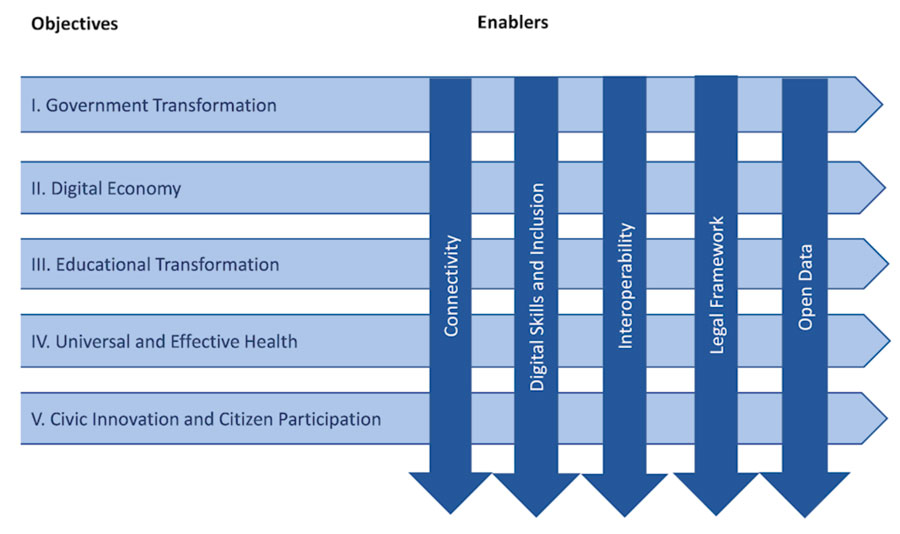
The EDN identified five strategic objectives that would drive the digital transformation of government, education, health, the economy and government-citizen relations (see figure below). These objectives are supported by five key enablers:

  1. Connectivity.
  2. Digital skills and inclusion.
  3. Interoperability.
  4. Legal framework.
  5. Open data.


Let’s see some of them in more detail:
Connectivity

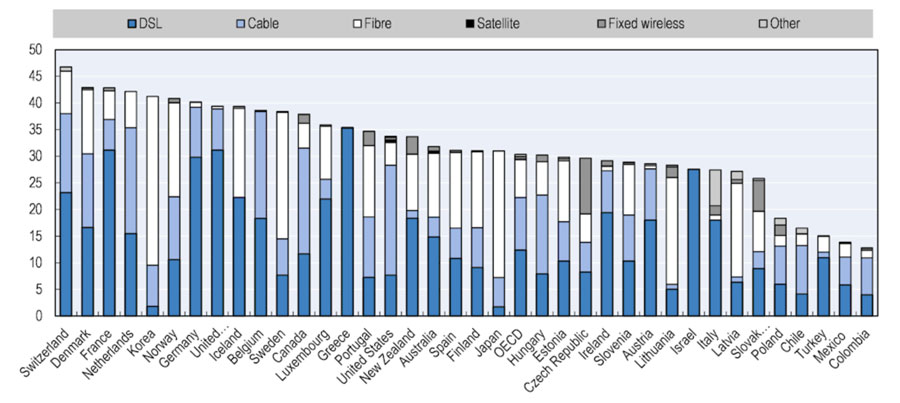
Access to the Internet and broadband was recognised as a constitutional right for all Mexicans as of June 2013, thus putting pressure on public authorities to live up to this standard. While Mexico still scores below the OECD average, it has experienced significant growth in the number of Internet users in the country, particularly after 2014.

While these are encouraging results, Mexico still needs to catch up to OECD peers in developing and adopting critical infrastructure for digital transformation, such as access to and use of fixed and mobile broadband. From a digital government perspective, Mexico would double down on its efforts to expand connectivity and inclusion, as it would allow the country to reap the full benefits from government transformation and the digital economy.

According to Statitsta, in 2022 the country had 98,64 million Internet users, representing 74,98% of the population over the age of six. By 2027 the number its expected to reach 122 million users. Internet users are highly concentrated, with 76% of urban people having internet access versus only 47% of rural populations.
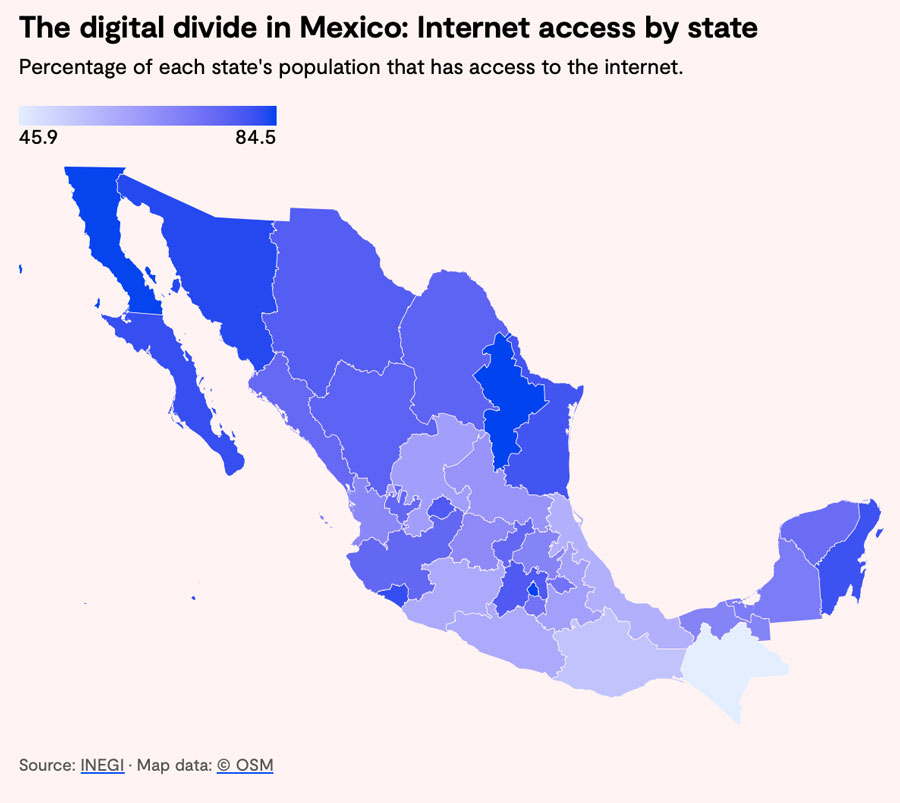
Source: Rest of World

The López Obrador administration’s main priority is providing universal connectivity through its Internet para Todos program, which aims to establish internet in rural and underserved communities, particularly in public areas. The program is run by CFE-Telecomunicaciones e Internet para Todos, a subsidiary of the Federal Electricity Commission (Comisión Federal de Electricidad or CFE), which was established in 2019.

The deployment of the project has been significantly delayed due to the COVID-19 pandemic and worldwide supply chain issues.
Digital skills and inclusion

The EDN also points out digital inclusion and the development of digital skills as critical factors making digital success possible in the country.

Mexico has set up important initiatives, such as MéxicoX, an online learning platform with over 230 courses for specialised and academic training for teachers, benefiting more than 1.5 million users.

Similarly, @prende.mx has provided schools with technological equipment and a knowledge-sharing platform for teachers on using technology as part of the learning process and has run pilots to improve students’ access to digital technologies and the responsible use of the Internet.

Interoperability

It is a structural enabler to achieving end-to-end digital services and seamless government. A seamless government would significantly reshape how the public administration operates, including between levels of government, to serve citizens better and become more agile.

However, they so far lack scale. Only a limited number of public services have adopted these solutions to achieve interoperability. In addition, these solutions do not give users full transparency on public institutions’ use and sharing of personal data. This final point could and should be considered for future iterations.

Legal Framework

As the government of Mexico seeks to enhance service delivery through digital approaches, it seems critical that frameworks such as those dedicated to ICT commissioning are revised or complemented to facilitate agile contracting and development.

For example, recently there’s been some debate over the high costs that the government has for the spectrum needed for the implementation of 5G services in the country. The official regulator has opened a public consultation to assess this, which has given market optimism.

Political leadership: creating an enabling environment for change

One fundamental weakness of the current Mexican model is that a disproportionate level of the political drive – and thus the ability to exert influence across sectors – depends on the individual executives within the Office of the President, who might often struggle to find the time required to effectively steer the digitalisation agenda.

Experience shows that while digital agendas operated from the centre of government can be highly effective, they also risk becoming too closely associated with a specific executive or political leader. In contrast, the digital government does not have a political colour.

Probably as a result of this, ICT’s budget for the last year was not spent in its entirety, only 40% as of November 2022. The budget for the next year, 2023, has only been increased by 4%, according to the consultant company Select, which will only cover inflation.

Collaboration between the private and public sectors is crucial in changing this situation. The government must understand technology as an ally for the country’s sustainable development and closing its economic and social gaps.

Challenges for the near future

According to CMD’s 2022 Index of Digital State Development (Indice de Desarrollo Digital Estatal 2022), these are some of the challenges for Mexico:

In infrastructure, to accomplish inclusive coverage. Networks of access that reach everywhere in Mexico so people and households can acquire and use quality services. Higher penetration of optic fibre and access to data. Also, 5G acceleration and the promotion of public, private and mix-owner clouds.

Regarding people and society digitalisation, Mexico will need to promote the effective use of ICTs (such as online financial transactions, shopping and selling, and governmental operations) that includes a gender perspective and allow for digital security and community development.

People also require more digital competencies and skills, so changes in formal and continuous education incorporating a digital scope will be needed.

Digital technology will have to be used to offer better priority services such as education, health, public security and environmental care and promote citizen participation in public affairs. Also, strengthen digital governance and regulations such as open data, access to services for people with disabilities, personal data protection and cybersecurity.

Finally, on companies’ technological adoption and innovation, it will be essential to invest in SMEs’ digitalisation (connectivity services, online presence and possibility of performing financial transactions), to accelerate the adoption of advanced and innovative digital tools such as Big Data, IoT or AI inside companies; and promote a preventive and active culture against cybersecurity. Electronic commerce is also possible given the agreements with the USA, Asia-Pacific region, Europe and Latin America.

Workplace gap: existing problem between supply and demand in digital technology

A challenging context

In the context of an accelerated digitalisation process, much is happening and changing everywhere and all at once. So what was true yesterday may have already changed today.

These fast-paced changes pose significant challenges for work and talent in the digital tech industry. On the one hand, the constant change results in difficulties in delivering updated educational content, a critical need for students and potential employers nowadays. On the other hand, as roles and their description change with new developments, companies have to design and rethink their teams as they go.

In addition, because of the Covid-19 pandemic and the consequent rise of remote work, the job market dynamic has opened to the world, and new competitors have appeared, threatening both Mexican’s private and public sectors.

The rise of remote work and talent retention

As of 2022, 48% of CIOs from top companies in the country confirmed they were planning their year ahead considering a hybrid work style, and 7% would do it considering remote-only alternatives. Although this represents more than half, a significant 34% planned to continue working in the office.

Candy, Mexico’s Ironhack Country Manager, explained that now, after the pandemic has receded, there is a growing tension between companies and employees as, in many cases, the latter don’t want to return to an office again.

Soundbite:

«No one wants to move anymore … more so in cities like Mexico when you need more than one hour to go from your home to where you work … it is a big challenge because some big companies don’t accept remote, and all Ironhackers want a remote job … so, it is complicated to do the match or explain them that they might need to begin in a hybrid job

Agreeing with this, a study by CodersLink in 2021 found that of all the professionals who worked from home during the pandemic, 90% don’t want to return to an office.

And it seems that payment could also motivate this, as the same study shows that remote work is the job alternative with the highest salary range, although the reasons for this are not entirely clear.

However,  remote work has allowed companies to hire candidates from foreign countries. This is the case for companies from the United States, which are now recruiting Mexican professionals. As a result, local companies have started to feel the tension. According to Select, a business consultant company in Mexico, 60% of its clients confirm having competed with foreign companies to attract and retain local talent. Making it even more painful is that this foreign interest focuses on those professionals with the highest training and experience in areas such as data science, cybersecurity, solution architecture and software development, which are much needed in the country.

Foreign companies, especially the ones from the United States, can offer better salaries and utility margins to local talent, so retaining them has become a challenge for Mexican companies. Companies, the industry in general, universities and ICTs promoters in Mexico need to redouble their efforts in cultivating specialised talent and offering more attractive working conditions

The most in-demand jobs

Digital tech professionals of all kinds, from project managers to cyber security specialists, are in high demand globally. In Mexico, 34% of recruiters say that there is a high demand for technology-related jobs. Still, the available talent does not meet the need.

According to El Economista, the following six job positions were in the highest demand: 

  • ITC project manager
  • Encryption, information security and cybersecurity analyst
  • Application and software developer
  • AI and automated learning specialist
  • Database and network specialist
  • Big Data analyst and specialist

Cybersecurity experts are one of the most demanded roles in Mexico, considering the recent security breaches the country has faced both in the public and private sectors. Although the number of this type of professional in the job market has indeed increased, there is still a deficit concerning actual demand from companies. The ISC2 organisation estimates there are currently 500,000 specialists, but another 260,000 are needed.

Hybrid profiles are also becoming increasingly relevant. These professionals specialised in more than one discipline combining different areas of expertise like human sciences with technology, business strategy with graphic design, etc. Michael Page describes them as the intersection between complementing expert perspectives. As one of the entrepreneurs we interviewed mentioned, integrating and translating different sources of information and points of view when doing business in digital tech, where the environment can be so diverse, is essential.

The report by the recruitment firm Michael Page claims there are two profiles at the moment that corresponds to this new hybrid trend:

  • Cybersecurity + Data: being able to work as a specialist in business strategy, managing complex databases while at the same time understanding security.

  • Product + Design: being a specialist in both product and design (UI/UX) allows for the efficient execution of ITC projects. This type of talent can understand technological implications and software language while optimising developments in the creative stage to deliver effective solutions to business-related challenges.

The supply and demand gap of talent

It is estimated that in Mexico, around 140 thousand job positions in the ICT industry remain empty every year.

It seems evident that demand appears to be higher than supply, but there’s also the case of the quality of talent. Luciano González Mendoza, founder of Trece Capital Humano, believes that professionals don’t have the skills needed by companies:

“Although there are people with careers on technology and information, tools have evolved faster than these people or companies are able to adapt».

In Luciano’s perspective, there’s a specific deficit in programming languages and agile methodologies, as well as skills in creativity, innovation and resilience under uncertainty.

The cause might not be only on the side of talent. When speaking to Ironhack’s Country Manager, Candy, she told us that most of Mexico’s most prominent companies are led and have been led for years by families. Family businesses are known for not being as open to new ideas as others. She believes they do not yet understand how to build an area for digital and tech profiles in their companies. This is reflected by the fact that, in some cases, they are looking for more senior experienced profiles to perform tasks more appropriate for junior levels.

Carlos, a graduate student from Ironhack, working now as an applications engineer salesman, also relates to companies not having a clear picture of who they need to hire. He tells us that during his job search process, he found out that many companies say they look for junior positions. Still, they expect at least three years of experience and more knowledge than you can usually find in a recently graduated professional. Carlos believes this has to do with companies not acknowledging the actual value of these positions or wanting to pay less than they should. Although this is the opposite case from what Candy expressed, both denote a lack of understanding of the digital tech hiring needs.

According to Factor Capital Humano, there’s a paradox happening at some companies. While 86% believe inside training could help close the gap between the supply and demand of digital positions, only 4 out of 10 have developed a well-defined training plan.

A different approach to education?

We spoke with the founder of a digital and tech startup in the Latam market, which bridges professionals with companies that might need their talent. He’s previously founded many other start-ups, including an online school. For him, with everything in the digital tech industry evolving and changing so fast, finding stability in the sense of something solid or stable is tough.

Educational content becomes outdated by the minute, companies seem indecisive about  the type of roles they need, and salaries are variable between the same experienced and skilled job positions. He believes that with time, certain things will take a much more definite form, as it happened with software development, a segment much older than, say UI/UX.

Because companies and students can’t wait for this to happen, education in this sector might need a different dynamic. As our founder interviewee believes, in the digital & tech industry, you do not need to traditionally become a professional, go to a university or receive formal education. It is more important what you make for your career by self-learning. He believes this is the most valuable skill: continuously educating oneself to keep up with a rapidly changing sector.

Educational initiatives for a better-prepared future

Considering the challenges in the digital tech workforce and thinking about the future, some companies and organisations have started to plant seeds for an improved and optimistic tomorrow.

Guzdan Services, for example, a mexican company for service integration and management, launched in December 2022 a foundation called “Apuesta y hazlo por TI para Transformarte” (Bet and Transform Yourself) with the purpose of opening opportunities for young people that have studied in a public school by helping them become more employable and capable of working in the digital tech industry.

Microsoft has a program called Virtual Innovation to strengthen employability in younger generations. So far, they have trained more than 145,000 Mexican students. Four thousand have been certified in AZ900, meaning they have highly specialised knowledge in Data Science, AI, the Internet of Things and Solution Architecture.

IBM and Tecnológico Nacional de Monterrey have established an alliance to train 620,000 students in high-demand technologies such as AI, Cloud, Blockchain, Quantic Computation, Cybersecurity and Open Source. This is to help graduate and postgraduate students develop skills that will help them occupy positions at companies where these technologies are being implemented.

The alliance will also allow students and teachers from the university to train themselves through IBM’s Academic Initiative self-service program, which brings access to software, selected courses and cloud related to the company’s tech solutions.

Gender gap. How big is the gender gap in the digital tech industry, and how is it affecting the sector?

The existence of a gender gap virtually in every aspect of human life is an undeniable truth, and its elimination is a challenge for our society as a whole. As pointed out by the United Nations in the Sustainable Development Goals agenda:

«Gender equality is not only a fundamental human right, but a necessary foundation for a peaceful, prosperous and sustainable world.»

Despite it being a fundamental right and having the potential to benefit all of society, progress hasn’t gone according to expectations, and there is still a lot to be done. Even more so after the COVID-19 pandemic, which represented a step backwards in what had been achieved so far:

«There has been progress over the last decades, but the world is not on track to achieve gender equality by 2030.»

The digital and tech sector has received much attention in recent years as potential leverage to reduce the gender gap. According to a 2018 report from the OECD called Bridging the Gender Gap Divide, digital transformation:

«(…) provides new avenues for the economic empowerment of women and can contribute to greater gender equality. The Internet, digital platforms, mobile phones and digital financial services offer ‘leapfrog’ opportunities for all and can help bridge the divide by giving women the possibility to earn additional income, increase their employment opportunities, and access knowledge and general information. We need to seize this opportunity to foster greater gender equality in the labour market, boost economic growth and build a more inclusive, digital world.” 

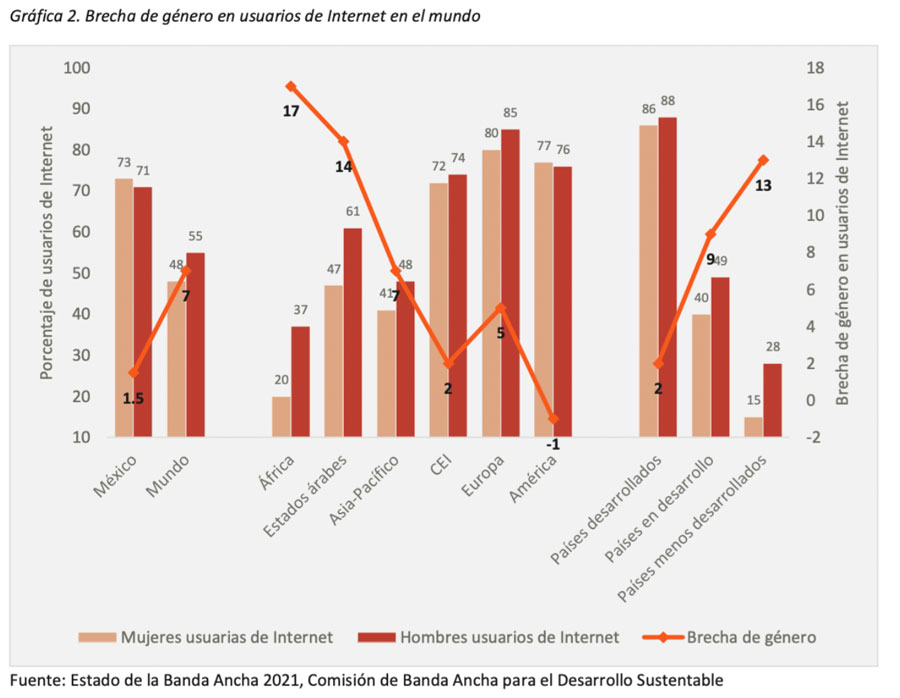
When assessing the gender gap in the digital and tech industry, it has most commonly been defined and measured as the percentage difference between men’s and women’s usage of ICTs, such as the Internet. In 2019, for example, at a global scale, 48% of women were able to use the Internet compared to 58% of men.

The importance of assessing this indicator is evident: A lack of connectivity results in reduced access to fundamental services such as banking transactions, medical information, education, job opportunities, and even entertainment, just to name a few.

At the beginning of 2022, the Centro México Digital (CMD) and the Confederación Patronal de la República Mexicana (COPARMEX) presented a study called «Gender Gap in ICTs» to help diagnose and assess these matters in the country and also widen the comprehension on the gender gap in Mexico. One of the most significant results shows that Mexico’s gender gap, based on its most commonly used definition, was 1.5 percentage points and well below the global gap, even the one in developed countries (as seen in the graph below).


CMD and COPARMEX decided to go beyond the self-complacency of looking at this indicator:

«(…) this national average hides differences between federal states, urban and rural areas, as well as between age, access location and socio economical level. It does not reflect gaps in time spent and type of usage being done by women either».

Having access to the Internet goes well beyond just being a user. It also implies owning a device from which you can connect to the Internet, the type of device itself and the location where the person is connecting to the Internet from. Considering these additional connectivity aspects (such as device, location, etc.), the gender gap would increase to 5.2 percentage points, 3.46 times higher.
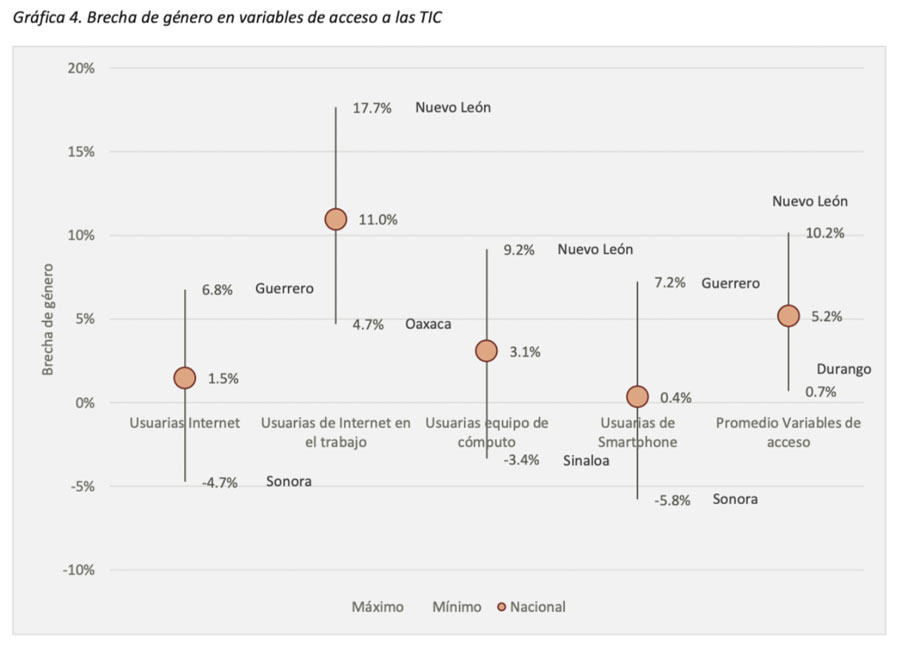
This assessment would worsen even more when looking at the gap in each federal state, which showed how uneven the country is. For example, while Durango has the smallest gap with 0.7 percentage points, Nuevo León has the highest with 10.2. Furthermore, when opening the scope to rural areas and lower income levels, the gap widens even more.

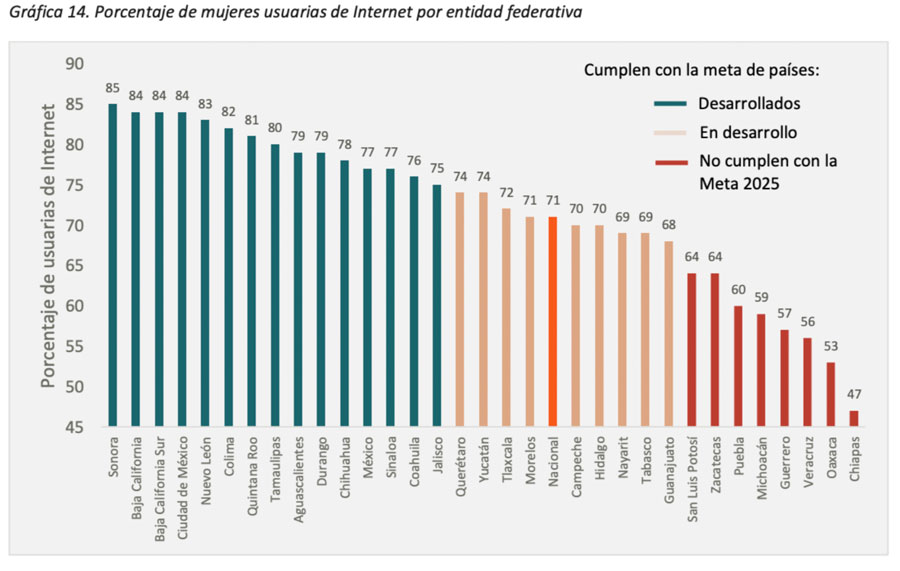
Another example: according to Metas 2025 (Goals 2025), defined by the Commission of Broadband for Sustainable Development (Comisión de Banda Ancha para el Desarrollo Sostenible), at least 75% of women should be Internet users in developed countries, 65% in developing countries and 35% in the least developed countries. In Mexico, 71% of women are Internet users. But when each federal state analyses this, inequalities appear, as seen in the following graph.
Besides access (5.2 percentage gap), the study also measured affordability (10.23), usage (2.4) and digital skills (2.9). The following graph shows the components of each indicator, reflecting how nuanced this measurement is and, so, the importance of having a deeper understanding of the gender gap situation in Mexico.
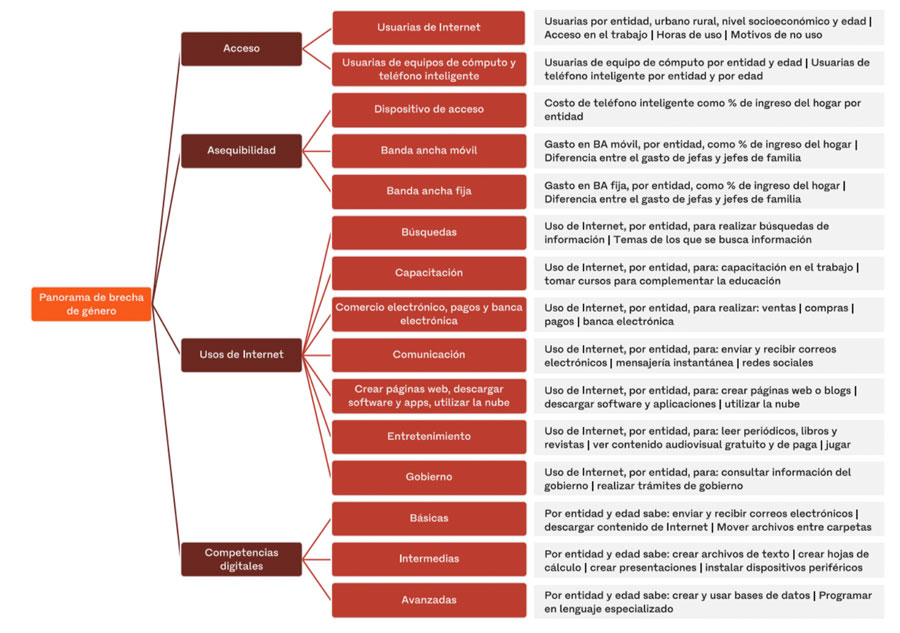
Regarding digital skills, men perform better than women in general, from the most basic ones, such as sending an email, to the most complex, such as understanding specialised programming languages. This gap becomes even wider with women over 36 years old. In contrast, the opposite happens with women between 16 and 25, signalling an opportunity to help girls develop even further in these competencies and motivate them to pursue a related career.

STEM careers (Science, Technology, Engineering and Mathematics) are not the most popular. According to the OECD, only 32% of students starting university choose a related career. But, then, of course, this aggravates when looking at data specifically from women, which account for only 12% of graduated students, according to McKinsey. The World Economic Forum’s 2020 report also points out that STEM education and abilities reach 14.46% of women vs 37.63% of men. This stems later to the labour force as only 10% of women who graduate in this type of careers enters it.

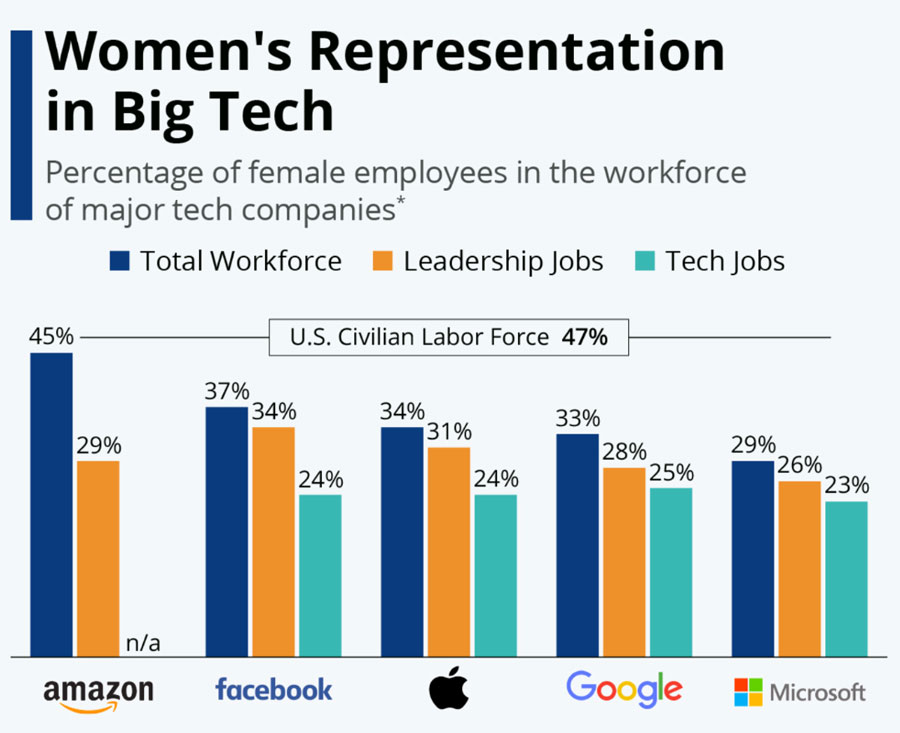
Although the number of women working in all areas of professional development is increasing — at 2018 they accounted for 44% of the economically active population according to the National Institute of Statistics and Geography (INEGI – Instituto Nacional de Estadística y Geografía) — their participation on the ICT industry reaches only 17%

Globally,  their participation is around 28%. This means that from around the 752 thousand mexicans working in an ICT related job inside the country, 127 thousand are women.
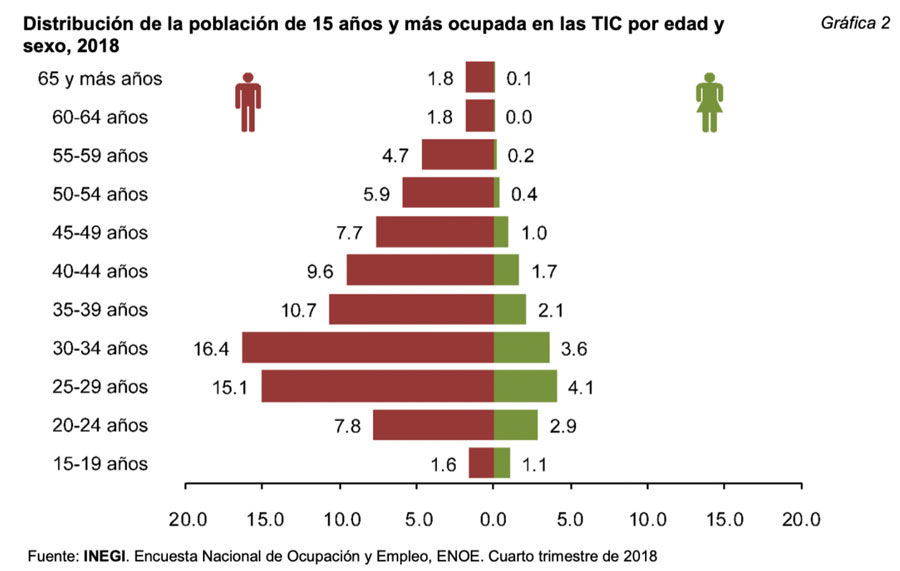
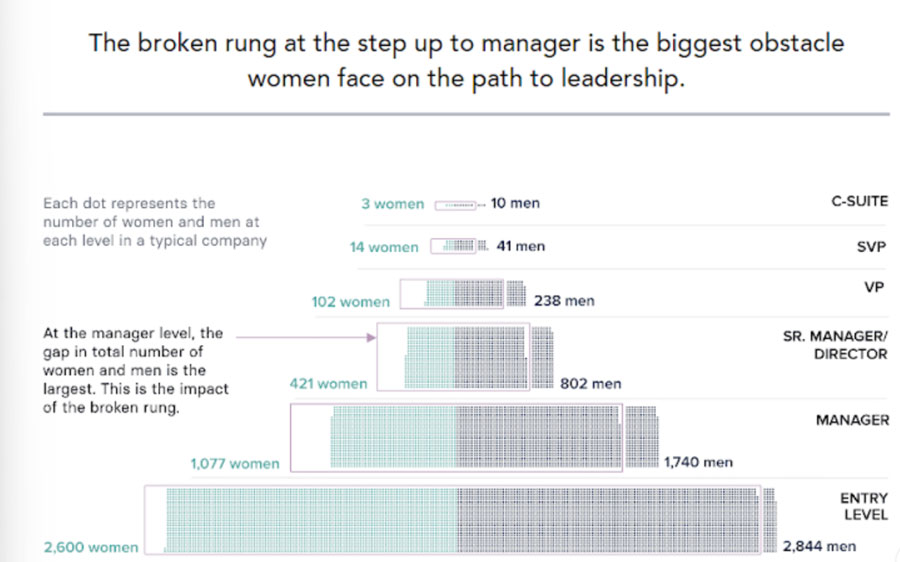
When looking at leading positions, a woman manages only 9% of digital and tech companies, and 23% of them have a woman co-founder.

A female participant that works as a recruitment expert in digital and tech profiles in the LATAM region told us that, based on her four-year experience in the field, it is more common to see men with more experience and in higher positions than women:

«To be honest … people who have more experience are usually men … they have more positions of management or heads than women … I don»t have the data but that’s my impression«.

Another female participant, a Key Opinion Leader from Mexico who works as a product designer and design system manager at a very important bank in the country, talks about the industry and design processes in a podcast. She explains that there might be different degrees of gender gaps in other areas of the industry. She believes there is a more significant gender gap in web development and marketing than in UX/UI areas.

Ironhack’s Country Manager in Mexico, Candy, says that less than 30% of tech students in the country are women, a percentage which is in line with what happens in the rest of the world. She believes that women in Mexico do not have the baseline conditions that allow them to study:

«The first one is financial independence. Women, we don’t have financial independence in Mexico. You depend on someone else … your family or your partner … also if you have a family, because we live in a machista country, that means that you would need three jobs: the job to pay for your bootcamp, doing your bootcamp and doing your home activities like taking care of your child. So the conditions do not, in general, allow women to have the time to do a bootcamp«.

A similar opinion is supported by experts who commented on the results from CMD. For them, the salary gap between men and women, which is 13 percentage points, has much to do with inequality in the country. Other data shows that Mexican women of all socio-economical levels dedicate more than 30 hours to non-payed domestic work and care. At the same time, in the case of men, it is around 10 hours (INEGI – Instituto Nacional de Estadística y Geografía).

In 2019, women’s participation in Mexico’s workforce was 45% compared to 77% from men. This was among the lowest percentages from the OECD countries (OECD – The Organization for Economic Cooperation and Development). Also, 61% out of the 4.7 million people older than 15 years that are illiterate are women. Women’s lack of access to education and the workforce leaves them vulnerable to wide salary gaps, access to leadership roles or advancing their careers at the same speed as their male co-workers. The digital tech industry in Mexico isn’t exempt from salary gaps: a male software developer can earn 26% more than a woman, despite having the same experience and knowledge.

The COVID-19 pandemic worsened this situation. In 2020, Mexico ranked 25th in the World Economic Forum’s gender gap global index out of 153 countries. But around mid-July of that same year, Mexico lost a total of 1.1 million employers because of the pandemic. By 2022, Mexico had descended to the 31st position in the index.

Although the landscape can seem discouraging, the existence of a gender gap means a lot of work to be done and many opportunities to be opened for women that can result in positive outcomes, specifically in the digital and tech industry. For example, closing the gender gap in STEM careers is estimated to sum over 800 million dollars to the Gross Domestic Product (GDP) of the country. Also, export companies owned by women can be 1.2 times more productive than those led by men, and companies with a female CEO employ 7 percent more women than those managed by men.

One example of an inspiring initiative that has been done in relation to women in the digital and tech industry recently in Latin America is the Women in Digital award (Mujeres en Digital), organised by the Asociación Lationamericana de Internet (ALAI) with the support of other organisations. Its purpose is to highlight the role of women inside the digital ecosystem. The news was launched on the 8th of March 2022, a significant global date for the women’s movement.

On this first occasion, the winner of this recognition was Salma Jalife Villalón, president of the Centro México Digital (CMD), which she created in March 2021 to promote a Digital Transformation that centres on people and Small and Medium Enterprises (SMEs). CMD has published different studies and reports about the digital and tech industry, one of them focusing on the Gender Gap. Salma is an extraordinary leader that has done a lot to visibilize women’s role in the economy and what is needed to reduce the gender gap.

Another example has to do with local organisations such as COPARMEX (​​Confederación Patronal de la República Mexicana), which, inspired by these events and information, have taken actions such as giving scholarships to women to facilitate remote work, workshop implementation to develop digital skills and the promotion of a salary pact with different organisations; which shows the importance of such initiatives to generate change.

Also, there is NIÑASTEM PUEDEN, a network integrated by women in the tech industry who come from STEM backgrounds and wish to promote this field of study among young Mexican students; and Codigo X, a programme aimed to consolidate efforts at the national and international levels in the industry, civil society, academia and government and promote the inclusion of girls and women in ICTs.

Another positive aspect of the digital and tech sector has to do with its perception of being a more open-minded space for women to develop. Carlos and Maria, graduate students from Ironhack, who’ve already had some experience working, describe the digital tech industry as very modern and inclusive. They do recognise that men still have an easier path than women, but that it is less so in the digital tech industry compared to more traditional careers.

The training offered by Ironhack to alleviate these problems

To learn more about how Ironhack in Mexico addresses the digital tech industry’s challenges, we spoke to its Country Manager, Candy, who shared her unique perspective on how this is being done. 

Candy comes from a science and technology educational background, owns a PhD, has led many incubators and developed companies in the digital tech field and does both research and consultancy work related to these areas of expertise, all of which are reflected in her point of view.

Amongst her responsibilities as Country Manager, Candy says that being aware of what is happening within the Mexican industry is crucial. She and her team need to figure out what companies are looking for in terms of talent and position their graduates in the job market accordingly, all while strategically thinking about how to make Ironhack’s business sustainable and keep offering value to their students under an ongoing global economic crisis.

Influencing potential students and companies

One of the challenges faced by Ironhack has to do with changing some culturally specific paradigms regarding how work and education are seen or experienced, both from a student’s and company’s standpoint.

Mexico is a country with a lot of public universities across its territory. As a result, its citizens can access high-quality education for free or at a very low cost. Ironhack’s challenge then resides in convincing potential students to pay for their education when they have yet to be used to it and see in its school a distinctive and attractive option because of its content and its return on investment potential. As Candy puts it:

Soundbite:

«In Mexico, there are tons of public universities (…) every state has one (…) which means people can go to the university at a really low cost. That brings the idea that you don’t need to pay for education, which is a big challenge because in Ironhack you have to pay for your education. It is complicated to put in people’s heads that this is an investment (…) that the money you’re going to receive will be higher than now«.

Now that the COVID-19 pandemic restrictions have receded, Candy believes this is a perfect opportunity for Ironhack to try and be in every digital tech forum it can and strengthen its brand positioning. «People need to know who we are», she explains. This, of course, includes the information that would motivate potential students and companies to be a part of Ironhack’s movement.

Regarding Mexican companies, some of them need help understanding the digital tech work dynamic and what could be the ideal team structure in order to achieve business-related goals. For Candy, this issue relates to family-run companies in a traditional manner, who tend to be less receptive to new ideas and more so in a dynamic and ever-changing industry:

Soundbite:

«The biggest companies in Mexico are lead by families. That means that you are not open to receive different ideas because you have grown in the same family with the same ideas. During COVID-19, for example, when we started working remotely, this companies didn’t want to do it, they didn’t understand how to do it. Now, that this companies need to digitalise themselves, they are looking for people, but they don’t understand they could train junior profiles, they orient to senior profiles only. They expect them to execute tasks, they do not understand this is more of a management-oriented profile that needs people working for them to lead them in the execution«.

This tension between potential employees and companies has been backed up somehow by Carlos, a graduate student from Ironhack, who tells us:

Soundbite:

«That’s definitely a problem from (the companies). I don’t know if it’s in all the world or just here in Mexico … you find that in every position you look for. They look for a junior because they want to pay like a junior, but they want someone who already knows how to do the same things pretty well. In my understanding a junior has between 0 to 1 year of experience maximum«.

Although resolving differences between students’ and companies’ expectations appears to be hard, it is not an impossible goal. As Candy says, once an Ironhack student is hired as an employee in a company, their reaction is amazingly positive, «... they want more …«. From there, influencing human resources and technical departments becomes easier:

Soundbite:

«It’s easy when you get one in the company, because as soon as you have one, they want more … they are the perfect doors to get into all these companies … to explain what they can do«.

Keeping up with the industry's pace

According to Ironhack’s Country Manager in Mexico, because the digital tech sector changes so fast, it becomes difficult for big universities such as Universidad Nacional Autónoma de México or Universidad Tecnológica de México, to keep their students up to date with the latest trends and job market demands. Because their programmes last between 5 to 6 years when students finally graduate, they fell short in relation to the market’s newest and most demanded competencies. This represents an opportunity for schools like Ironhack that can offer short-length programs and update their content more frequently:

«I used to work in the biggest universities in Mexico, UNAM. If you go to UNAM and look at their career programs, the last changes they did was about 5-6 years … this means that if you go to study to a university, the program you are going to follow is about technologies of more than 5 years old. So, what is happening is that people who finish university can have amazing soft skills for other things or even some knowledge that is useful, but they don’t have the tools to go into the industry. That’s exactly what we’re doing in Ironhack«.

Although this is a competitive advantage, Ironhack still needs work on adapting its content effectively. Candy explains the school’s global team does this regularly to be in line with market demands. Still, when specific local-related market needs arise, Ironhack’s reaction to adapt course content can take longer.

Challenges inside the classroom

Candy is proud of Ironhack’s value proposal: it involves delivering the best technical knowledge in the market, having students learn from experience, receiving orientation from experts and collaborating with classmates. This sets Ironhack aside from traditional universities and self-learning platforms like Platzi:

«… you are going to have a teacher all time, but you’re going to learn by doing … if you are the kind of people that can learn by yourself through videos, maybe Ironhack is not for you … but if you need someone to help you understand what is happening Ironhack is for you … what you are going to get from Ironhack is experience, because you are going to do labs and projects, have personal feedback, you’ll be with a teacher all the time during class, and you’ll have people in your class to share your doubts and concerns and experience …«.

This educational environment might appear ideal on paper. Still, it involves some difficulties when trying to make it a reality. Candy says students need more than a nudge to deliver what teachers ask of them in terms of homework, for example. Being able to grab and hold their attention during an entire class is also demanding. She says they’re trying to mix the lecture parts with those involving labs and projects to see if that helps.

Being able to study remotely definitely has its benefits, but Candy believes it is also why motivating students has become so complicated. The same happens with group interaction. The student-teacher relationship is better maintained remotely, but the one with peers for collaborating through teamwork is a challenge. Students seem to be more confident in approaching someone when encountering them face-to-face in a classroom, Candy says.

Labs and projects, the practical side of Ironhack’s teaching, intends to develop this soft skill, even in a remote setting. Candy explains they don’t have specific classes for teaching soft skills but give students different tasks needing soft skills such as teamwork, presentations, organising their time, focusing, and others.

Helping students get a job

A valuable element for students provided by Ironhack is the training they receive at the end of their course:

«At the end, what Ironhack has is something we call Career Week … one week to figure out what to put in your CV … put your LinkedIn profile in a perfect way as to be more employable … practice some interviews and technical interviews and be in a good fit for finding a job …«

Candy tells us many junior profiles are getting into the market nowadays, so students need help finding what makes them different from others. So Ironhack wants to help them find that element of differentiation and competitiveness that allows them effectively introduce themselves in the job market.

Supporting women

Candy is aware that certain societal structural conditions they can’t control, such as living in a patriarchal society, so there’s only so much they can change.

A few things that are being done locally at Ironhack Mexico to alleviate this is to offer specific discounts or payment packages specially designed for women to motivate them to study while helping at the same time with easier access to education that otherwise would be costly for some of them.

Then, with women already studying at the school, providing information on women empowerment to motivate them and promoting the a network of support is also relevant. So, for example, promoting feminist groups among students and sharing women’s success cases like women balancing studies at Ironhack while working and taking care of their family or others that have been hired at great jobs in the industry after studying with Ironhack.

Candy herself belongs to feminist groups and is a woman, of course, which itself is an excellent example of the changing times. Another example is Salma Jalife Villalón, president of Centro México Digital, an essential referent for understanding digitalisation in the country and a promoter of development, inclusion and well-being through its promotion.

What do experts say?

A need for strategic vision and decision-making involvement

F. is the founder and director of BEU, a digital platform that helps content producers share and sell their work online.

He got involved in the industry at a very young age by learning how to program at school, where he wrote his first code at age 13. After graduating, he went on to follow a career in software engineering at the university. He worked for 12 years as a developer in a company and then left to look for a different place for him to innovate. He eventually moved away from coding to explore the intersection of technology and business in what he calls «digital product strategy, » which he’s been focusing on for the last few years.

F. has developed several start-ups. The last one was an online academy focused on UI/UX learning which he and his partners saw as an important opportunity back when they started it. F believed now and still does today that there’s a deficit in technical and theoretical knowledge in LATAM professionals and their practical experience and strategic thinking capabilities.

He believes these schools are too focused on operational aspects and not so much on strategy and business-related questions, making decisions and integrating different sources of information. He says many good professionals can do the work but do not think independently regarding business and strategy.

Another expert in the field, J., agrees with this conclusion. She started her career as a graphic designer, working in branding. She expanded to photography and editorial design and eventually landed in UI/UX. Nowadays, she works as a product designer and design system manager at an important bank in Mexico. She leads different side projects, like a podcast about the tech industry and an online academy that offers digital tech courses.

In her opinion, having a strategic mindset and being familiar with business environments is what recent graduates lack the most, and it’s what schools need to help them start their careers and bridge the existing professional gap in the industry:

«So my overview of the tech industry, at least in Latin America, is that we have strongly developed teams, but they are only producing and there are gaps … something that we learn in the process of making the design school is that the market is demanding professional profiles that focus only if they can use Figma, or code in the latest and most trending programming language … and I think that is why bootcamps are so popular nowadays … because they prepare you for what the market needs … but not necessarily for what the companies or their products need … I think it’s okay to have the foundations and the basic to start working but there is more out there … I think the mission for schools is to prepare people but also work with them in a real environment where they can learn how it is to work in the real industry, because when they go to work they don’t have the skills to interact with different people … you can only develop this by working in challenging and changing environments … that is the real school for me … «.

For F., part of the problem resides in the lack of professionalization in these careers. In his opinion, an education and a career can get to a higher level of professionalisation after accumulating and consolidating knowledge that has been developed over time, having research, metrics and standards that back up this and their study plan, etc. Most schools and educational platforms that have appeared during the last couple of years don’t go as deep as a professional formation would and just cover the basics.

F. believes this is partly because schools don’t find this profitable; they provide fast education and insert students into the workforce as fast as possible without committing to challenges that may come afterwards when they need to sustain themselves in these positions. Ultimately, they offer the junior market profiles with the least necessary knowledge to do operative work. Still, they do not learn things related to strategy, which is needed and lacking in the job market.

For J., companies also have a responsibility to integrate digital tech professionals in strategic decision-making. As someone from a UI/UX and design background, she feels that the human-centred vision given by her profession still doesn’t have the relevance it should. In relation to this, F. talks about an opportunity at the intersection of social sciences and technology, being that companies do not completely trust professionals having the former as a baseline foundation, but rather those who come from a more technical background, persisting on this division when the integration can be powerful.

There is hope, looking at this from F’s perspective. He says that what he loves about the digital world is the power of community. He shares the example of Figma, which started in a small community and then continued to expand rapidly until Adobe decided it was a business opportunity and bought it. This bottom-up process, when it comes to changes in the industry, is something to find inspiration on.

Most in-demand jobs & skills

For F., the most in-demand profiles at this moment are those having to do with data analytics and Big Data, growth hack marketing and software developers. The reason behind Big Data is that companies have to deal with huge amounts of information nowadays, so there’s a need for this kind of professionals to help them deal with it. Secondly, in growth hack marketing, these are professionals who identify opportunities in the market and design strategies on how companies should take advantage of them quickly. Their relevance for companies is explained in their own job description. Finally, there are developers, which are important because, as F believes, every company will eventually need at least a website, even if they are not in the tech industry. And developers do that.

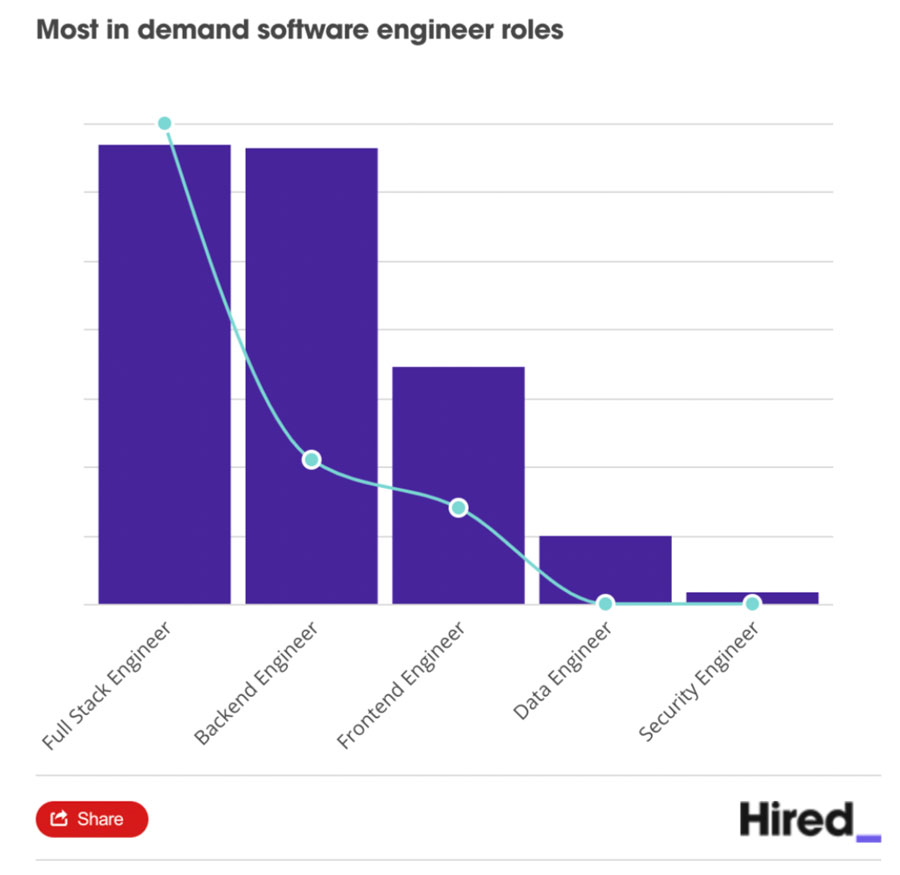
S. is a psychologist who works at a recruitment company specialising in recruiting digital tech profiles. In her experience, there is a higher demand for IT and technical profiles rather than digital ones. Specifically, she mentions backend, frontend, software and BI as the most wanted.

An interesting insight she shared, related to the hybrid profiles mentioned before, is that companies have been looking for a way to condense different abilities into as few people as possible. Is what she calls «generalist profiles», professionals with knowledge and experience in different areas who could cover more than one position to reduce costs for companies, a growing need when there’s global tension in the economy.

Regarding specific skills, in F.’s opinion, one of the most important has to do with the ability to communicate ideas through digital content, for example, recording yourself in a video to explain something you’ve created and allowing others to understand the content without you being present. This is becoming more valuable as companies work in different time zones, which F. calls asynchronous work, which he believes will become a stronger trend in the near future, given the remote work possibilities.

English is also a very valuable tool that helps professionals work internationally. And the capacity to adapt quickly. The industry itself changes by the second, and the current political and economic global environment also needs us to adapt, says F.

Another skill that he considers crucial and a big differentiator is the capacity for self-learning. It is something that companies find very valuable. Because the job market needs are changing so fast, professionals that can adapt themselves are the ones that stand out the most.

For J, who’s also a promoter of self-learning, critical skills include negotiating inside the workplace, assessing trade-offs in negotiation processes, a passion for teamwork and collaboration between specialists and professional profiles, and practising empathy and active listening.

She focuses a lot on the human connection aspect of digital tech. For her, having this mindset makes a lot of difference at work and it’s what the world needs the most to achieve tech progress. She believes that foundational technological knowledge can always be updated and learnt in the process, but the capacity for human connection is harder to develop.

Trends for the near future

says there’s a lot of talk about the technical aspects of the future in digital tech, like AI or blockchain, but what he finds more interesting is what has to do with human interaction. Asynchronous work, for example, which he refers as the possibility given by remote work for teams to work in different time zones, continuing the work of others while they are sleeping.

Also, not having hierarchies at work. He believes this will disappear in the future. There will always be a common objective in a team or group of people working together, but there will be no status higher than one of the other. Rather, there will be situational leadership, for example, a psychologist emerging as a leader when there is a challenge where his abilities are crucial.

Decentralised corporate governance is a related thought. As decisions are more data-driven, these will start to replace a big boss’s vision or power influence.

Regarding jobs, F. thinks there will be a strengthening of roles related to blockchain and how to take advantage of this technology for different companies and business sectors. Content creators that now have the form of influencers will be more professionalised. People who can communicate with different publics through content, what before was called content managers in social media. Cybersecurity specialists will be more needed and will have to be more experts. Life will become increasingly digitalised, which can impact people’s digital and physical safety.

In technology, automatisation in environmental and agriculture-related fields will be bigger while reducing world hunger becomes more critical. F. says he can picture a future where automated crops could help augment production more efficiently.

For J. this will also be true for working processes in their industry, like prototyping or coding, which will help professionals in this area focus more on the strategic part of their roles, making this aspect of education even more critical for schools to meet companies’ expectations.

Regarding AI and the Metaverse, F. believes these are hyped at the present moment. They are more of a novelty, but they still need more technological development and critical mass adoption for them to have a real and important impact on human life. In the near future, he believes this will change, making it possible for teams to work remotely through avatars or create content through AI, and in everyday life, like the refrigerator helping you do the shopping order on time. Like everything, the risk will not be to make people more sedentary, passive or lazy. 

For J., the industry has to strengthen a human-centred mindset. As the focus seems to be on the technical aspect with innovations such as AI and the Metaverse, she believes we can stop thinking and reflecting about the effects of this in society and keep that in mind all the time.

Advice for newcomers

F.’s recommendation is to begin with online platforms instead of formal education because it requires lower investment and less risk. He remembers having given this advice recently to a young nephew. He told him to use a small percentage of the money he was planning to spend on education to start exploring with 2 to 3 online courses. F. I believe this path helps you choose the specific discipline you want to start with and decide if you wish to educate yourself in it. For F., universities are no longer a requisite for these types of jobs. Results and knowledge are what are most valuable.

Whatever the form it takes, J. believes educating yourself and studying a lot is crucial for having a career in this business—doing masterclasses, long courses, short courses and  building your CV with certifications. Similar to F’s vision, you build yourself up along the way.

J. adds to this process: learning from other people. Back when she was finding her way in the tech industry, there weren’t schools like there are today, so speaking to people who were already working in the business or even related in some way was of great importance and guidance.

For S., networking is crucial as well. She recommends not being shy to approach experts in the fields we might be interested in and ask for feedback on our own work:

Soundbite:

«Have a good CV or resume and portfolio, which is very important … do networking, follow someone who has experience in the area that you are interested in, send him a message to ask questions, if they can take a look at your CV … use Facebook or Behance to connect also … it can be frustrating at the beginning, but just say ‘hey’ … people are cool, they will help … maybe share what are you doing, that is going to help you«.

Also, for J., a critical alternative to start gaining experience is collaborating with entrepreneurs and having an exciting background for one’s resume. Many companies ask for experience in the industry, and this makes it hard to begin. Small businesses might not have much money to cover a significant paycheck, but they can offer excellent learning opportunities. Having side projects and an entrepreneurial spirit is also a valuable asset in this industry, where building yourself up might be necessary.

Finally, S. shares an illuminating step-by-step process anyone could follow before deciding to pursue a career in digital tech: start with asking yourself why digital, identify the purpose, and then research it because the digital tech world is so big you might need to find your growing space first, finally going deep in that area you are interested in and not be afraid or reluctant to change:

Soundbite:

«… why would you like to be on the digital side … is it because of money, because it is interesting or you saw a friend who is a cool guy … invest time to research what the digital world is about … is a big world … you need to see what is the digital world … after that you invest time researching the different profiles to see what matches with you … maybe something calls your attention … and you say you would like to do UI, learn about Figma … maybe is something you like but you don’t have the abilities … and then you start the improvement … also, every person can build their own career and it is good to change things … I mean, if you have interesting in something else, just learn about it and then combine it … if you want to improve your career, change to a different area, try it!«.

Trends by sectors

Web Development

As also said by some of our interviewees in previous sections of this report, web and software development will become more and more demanded by the job market as everything we do becomes more digitalized:

«Digital transformation may sound like a buzzword, but as more of the planet arrives online, as business owners become more creative and explore new distribution channels – as our lives evolve, we need software engineers».

This is evidenced by the high demand that exists for this profession in the job market that sadly is not being met by its professional offer.

A report titled Talent Shortage by the company ManpowerGroup says that 69% of companies globally need help finding candidates with the technical and professional abilities required to fill their vacancies, and in the case of Mexico, the number of companies with recruitment issues is around 74%. 

Only in the ICT sector is the shortage estimated for programmers around 50,000 people, which will impact the sector’s development and innovation capacity.

Another study by Indeed identified 15 job titles with many vacancies that have remained unresolved for more than 60 days, more than 30% of those related to web and software development.

The problem is not only with the number of available professionals but with their preparation.

Because programming languages change so fast, some considered popular before are now old, and today many companies have migrated to Xamarin, React and others, which not all professionals are prepared for.

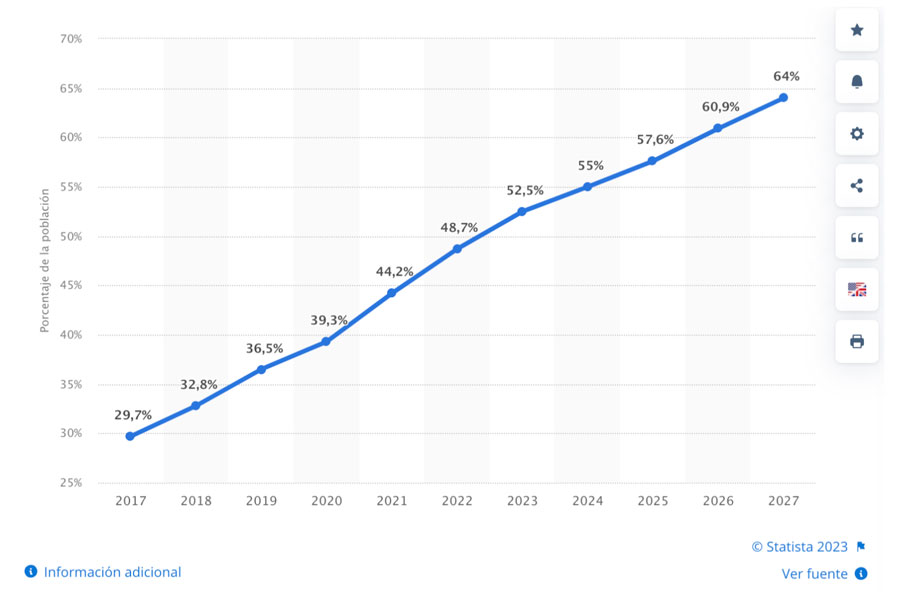
With e-commerce growing consistently over the years, this demand will only grow. According to Statista, and as seen in the graph below, the percentage of online buyers will have increased to 64% by 2027 in Mexico, becoming one of the most important e-commerce markets in the whole continent, only behind Brazil.
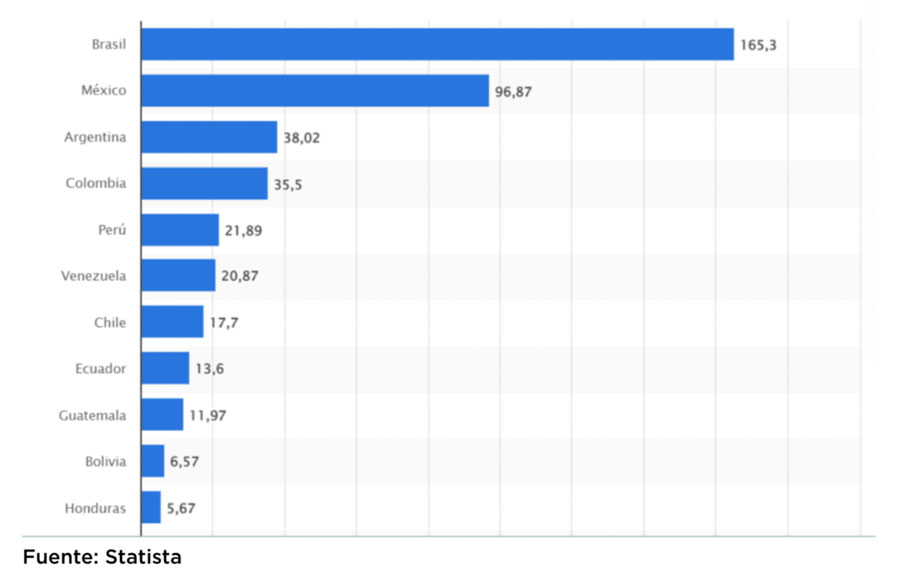

According to data from the Mexican Asociation of Online Sales (AMVO-Asociación Mexicana de Venta Online), in 2022, e-commerce amounted to 401,000 millions mexican pesos, having grown 27% compared to the previous year. Still, there’s a lot of space for this to grow. In 2021, only 6 out of 10 SMEs sold online.

Regarding roles, Hired, a company with a marketplace platform, analysed data «of more than 366k interactions between companies and software engineers» and also surveyed «more than 2,000 candidates» to build the State of Software Engineers Report for 2022. They found the following to be the most wanted profiles inside the Web Development area:
According to Talent.com, based on information from more than 3 thousand data points, the average salary for a web developer in the country is 14,000 Mexican pesos a month

Compared to other job titles, Java, a valuable skill in this same discipline as Web Development, has a better probability of a better payment.

Information shared by DPL News, collected by IEB Business School, on the best-paid positions in the country also pointed out Java Developers as one of the highest, ranging between 25 to 30 thousand Mexican pesos a month.

With Java and JavaScript, there’s also a strong presence of Python, all with an ecosystem that continues to evolve and keeps relevant in the job market. Still, other programming languages like Rust or Go start resonating for being more productive, efficient and scalable.

Other trends include the development of cloud-related systems like Kubernetes. And everything having to do with Blockchain beyond momentary transactions like smart contracts or authority validations.

Data Analytics

With digital transformation, companies have gained the capacity to gather a lot of information but need to learn how to process and analyze it. Everything around us today could be turned into data, from taking a taxi through our phones to searching for any information on Google.

Data analysts are required not only to understand this information but also to help companies make strategic decisions and turn that into growth for the business. That is why having a strategic and business-oriented mind can also be key for this type of role, aside from being experts in the technical part.

Data analysis is evolving rapidly, and in the process, it is integrating new technologies like AI and automatisation. Recent advances in AI and machine learning allow data scientists in the credit and finance sector, for example, to create risk assessment models, helping institutions reduce the probability of no-payment. Applications in transportation services and tourism have also shown interesting insights and results.

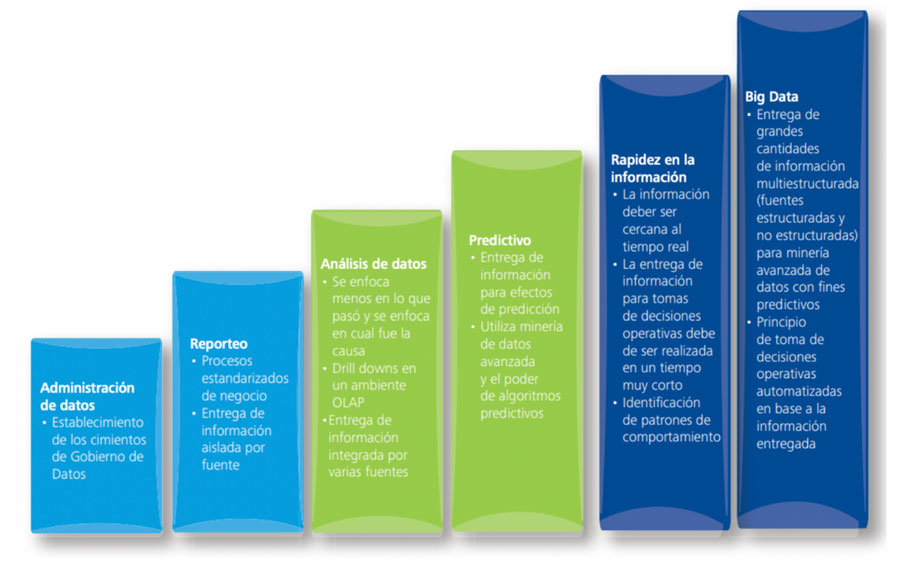
It is vital to consider the perspective shared by Deloitte in a report from 2013 that still resonates today on the different stages a company could be in related to data analysis. Building an analytical data culture in an organisation takes time and resources, and identifying where in the evolution process one’s company is in could help make better decisions regarding data and its management (see the following graph for more detail).
A report done by ResearchAndMarkets.com explains that Mexico’s data centre market is expected to grow at a CAGR (Compound Annual Growth Rate: «the mean annual growth rate of an investment over a specified period longer than one year.») of 9.37% during 2022-2027.

The major factors driving this growth are cloud adoption, implementation of AI, Internet of Things (IoT), big data, digital transformation, 5G network commercial deployment, gaming culture, and smart city initiatives.

As with web development, Big Data also supports the Cloud Computing industry’s growth. The cloud offers bigger capacity, security and access in real-time to data vs servers being installed inside companies. Cloud relevance encompasses data analytics growth in that sense.

The country also has around 28 operational colocation data centres, including 11 cutting-edge data centre facilities operated by the KIO Networks. Industries such as cloud, telecom, BFSI, and healthcare. In addition, the government, which is shifting its workloads to the cloud, is the primary demand driver for colocation services.

Data analysis is one of the most important emerging jobs of the future, which will take advantage of the more than 40,000 million devices connecting to the Internet as of 2025.

Glassdoor says it is between one of the ten better-paid positions in the country with approximately 20,000 Mexican pesos a month. And for IEB Business School it is between 15 and 25k a month.

UX/UI Design

Internet usage and digital habits have changed during and after the pandemic. According to a study done by GSMA, since the COVID-19 pandemic, the number of unique mobile users in LATAM will increase to 485 million by 2025. 

Another data from a report called Digital Society in Latin America 2020-2021, from Telefónica Hispanoamérica, found mobile data traffic had a 60% increase, while fixed networks a 47%.

People are more connected through digital devices and interfaces than ever before, making UX/UI a fundamental tool for designing memorable and satisfying  experiences for people to have on this technology.

In an interview with El Economista, Teresa Mendiola, a UX consultant, says that the «dream team» for building the perfect website should be composed of a designer with a focus on UX for creating the mockup, someone specialised in SEO, a researcher of UX, a programmer or developer and a content creator with a focus on SEO and UX. And the importance of this profession transcends websites to every digital product possible. It shouldn’t be a surprise then that in some companies, the UX department can have more than 70 employees, says Teresa.

Aside from being an attractive position in digital companies, it is also well-paid. The average salary for a UX/UI designer, according to Coderslink, is 40,000 Mexican pesos a month for 2021. Coderslink gets this number from remote work and medium to senior experience job listings, which is why it surpasses the most common average of 22-26 thousand coming from platforms like Glassdoor, LinkedIn, Payscale and Indeed. Other sources claim salaries range between 28 to 30 thousand.

Regarding trends for the following year, UX Collective shares some interesting insights. It is an independent publication built to help designers think more critically about their work. Every year since 2016, they’ve published a report on global trends in the UX discipline. For 2023, their latest one is called «A vibe shift is coming«. The one for 2022 was called «Rebuild«. The message in the latest publication is that «it is time to think critically about the direction our industry is heading —and the path we want to walk ourselves».

The publication reflects on the recent layoffs in some of the most prominent digital tech companies, which has resulted in what is now being called quiet quitting, as employees feel emotionally detached from their workplaces. The possibility of a tough recession diminishes optimism in some.

Amid economic uncertainty, companies are starting to lean towards more pragmatic decisions and focusing on ROI (Return Of Investment) when making them. This impacts UX professionals who advocate for users and are now being asked to put profit on top of every move.

AI impacts many different industries and tasks that do not exclude UX experts. The advice from UX Collective is not to be afraid of how this technology could take their jobs, but instead, to start using it to collaborate and find different and more efficient ways to do things.

Although this news could bring anyone’s mood down, they could also be seen as opportunities and challenges to strengthen one’s career and keep UX/UI as a relevant force in the digital & tech industry, one that keeps human centricity at the core of the business.

Cybersecurity

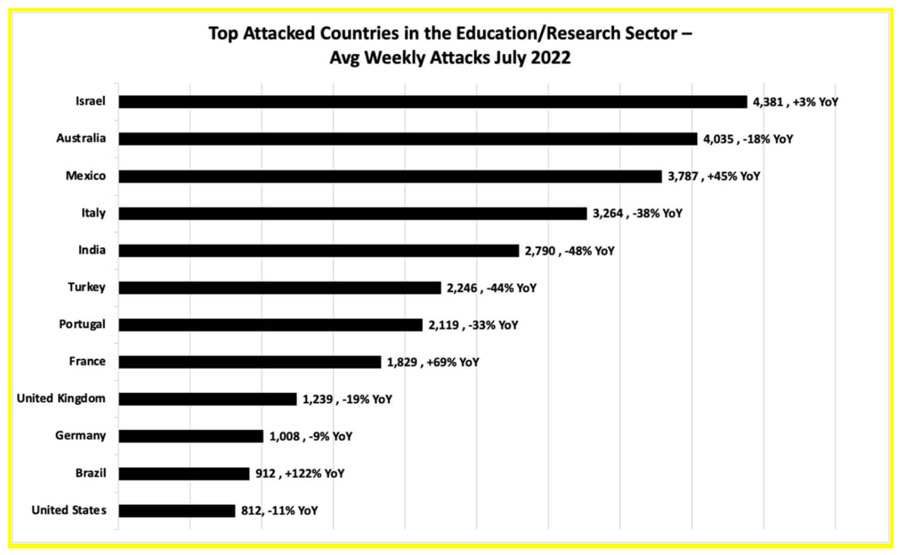
One of Mexico’s biggest concerns nowadays is protecting the country against cyberattacks. A global trend report on the matter done by Check Point Research said that in July 2022, Mexico reported an average of 3,787 attacks per week, a 45% increase compared to the same month in the previous year.

Mexico is receiving a very large amount of all cyber attacks happening in LATAM. Hackers seem to have in sight all types of industries and companies, from big corporations to SMEs, the banking system and government offices.
Security concerns represent an obstacle for the digital ecosystem, as consumers’ confidence in e-commerce or online banking is less stable. The Mexican Internet Association estimates that only 22% of internet users buy goods online, and only 17.6% conduct banking operations. Thirty per cent of Mexico’s internet users have concerns about online fraud, and 28% are unwilling to share banking information online.

For DPL News there’s a significant delay in cybersecurity policies on the government’s side. Countries like the USA or Israel have had a national security strategy for over two decades. Only recently, after security attacks on Mexican gas company PEMEX, the secretary of economics SE, infrastructure, communications and transport secretary SICT, and the national defence office SEDENA, has received attention. Considering 2023 will be a pre-election year, risks might arise

Mexico doesn’t have a Cybersecurity Law, although some general dispositions typify a digital crime. This is insufficient as they do not establish the necessary mechanisms for risk management, protection against attacks, incidence detection, and implementing a cybersecurity strategy and culture.

The Senate and Congress are working together to develop a Federal Security Law Cybersecurity and the building of a National Agency for Cybersecurity. This law will guarantee national security by defending cyberspace with a renovated legal framework to help fight back and punish cyberattacks. At the same time, the agency, controlled by the executive power, will unite civilian and military forces to protect the public and private sectors from these attacks.

This worries companies in the private sector that expect hacking and information filtration to be the highest concern in their sector. PwC advises them to build a cybersecurity strategy, independently of the legislation, that focuses on risk prevention across all levels of the organisation.

The consultancy company refers to the position of the CISO or Chief Information Security Officer as a key element in this. Usually, this position is more operational when it needs to be more strategic, especially in risky environments like Mexico at the moment. Only 37% of the companies assessed by the study done by PwC said this role had the responsibility of coordinating the company’s response in the event of a cybernetic attack, and 28% said it was responsible for assessing associated risks with business decisions. This shows an important opportunity in the growth of this role at companies and for students interested in this career line to have an idea of what might be expected ahead.

Salaries for positions in cybersecurity, according IEB Business School, can range between 35,000 to 45,000 Mexican pesos a month, being one of the best-paid positions at the moment, as well as one of the hardest to cover.

Product Management

The discipline of Product Management is a relatively young one. It lives in the intersection between UX, business and technology, and there can be different types of it depending on their focus: technical, marketing, data or design.

According to IEBS, a blog on digital technology trends, the product manager or product owner role will grow in demand. Because it is a role linked to growth in digital consumption, it could keep gaining relevance in the job market. They say it requires a particular mix of knowledge in tools like Scrum or JIRA, and soft skills such as time management, communication and being organised.

Carmen Consuegra, a product manager herself, believes a professional in this area must be highly flexible to adapt to sudden technological changes. She says it is key to keep active and learn. Also, being a leading position, it is critical for this role to have a comprehensive and updated knowledge of the newest technologies and trends and the many professions of the team it might lead.

Global trends that could impact the landscape of this role in Mexico include increased use of AI in many areas of product management. For example, it is already being used for user segmentation, but now it could start being used for iteration processes and testing, which would eventually get automated. Also having to do with AI is its presence in products as a feature, like chatbots in automated customer service.

Product ops is a new role inside product management, ensuring the product runs smoothly and meets the customer’s needs. They focus on operationalising processes regarding products, doing segmentation, tracking customer feedback and managing performance. It is a role that is becoming significant as product management becomes more complex.
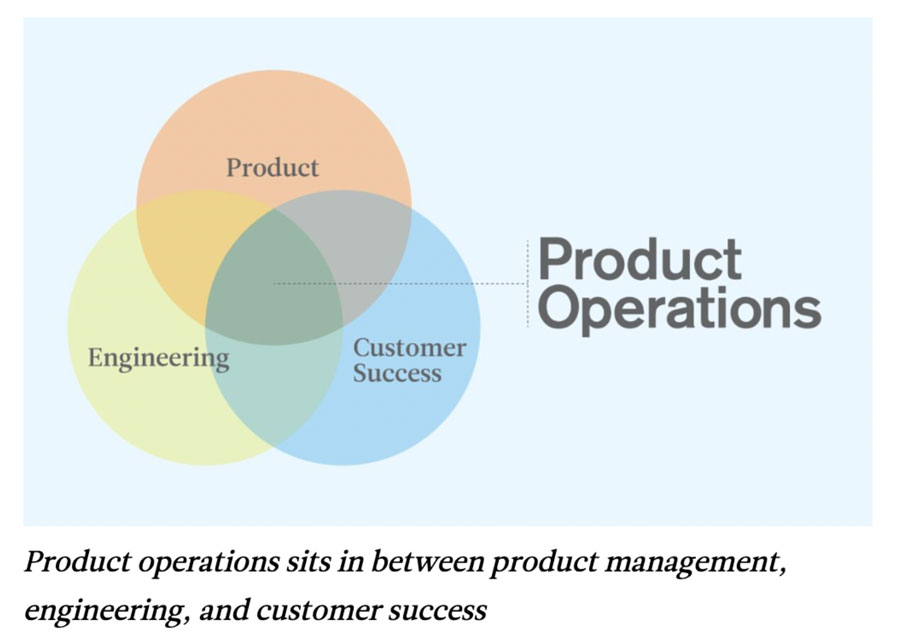
Another trend is being able to deal with rapid product feature iteration and improvements. Methodologies like Scrum or Kanban could be helpful here. Finally, bringing data to decision-making.

The average salary for a position as a Product Manager, according to Hireline, could be approximately 40,000 Mexican pesos a month. The job platform Talent reaches the exact number but on the higher part of the range, an average of 15,000 and a minimum of 8,000, based on 408 data points. 

Career Development

According to Michael Page, organisations are considering significant investments in their digital or technological tools for the following year. Six out of ten companies see this industry as a priority for their businesses, especially regarding collaborative software, customer relationship and communication management tools, and cloud services. This helps professionals to have an anticipated perspective on what the job market could be like soon. ICT profiles in data science, agile, scrum, machine learning, AI and digital marketing will still be attractive this year.

Digital professions continue to grow because of the times we’re living in, where social and technological changes and transformations apply to aspects of everyday life to the way we do business. Companies now demand new leaders and digital profiles to approach the challenges of digitalisation .

As we have stated before, there is a growing number of professionals in certain areas that should fill open vacancies. However, companies still feel this offering needs to be more adequate in terms of talent and abilities. Many factors could contribute to this. For example, according to GetOnBoard, some companies have started to offer hybrid or location positions, which professionals don’t find attractive, there are many JavaScript-specialised professionals but companies are requiring expertise in different programming languages such as Java, NET, Oracle; and some salaries are beginning to slow down because of the effects of the global economy.

As suggested by our group of experts, self-actualisation can be a crucial asset for growth in this business. With the digital & tech industry changing every day, the best way to keep being a good fit is to keep updated and adapt to the different circumstances.

New future trends and paradigm shifts

At the start of 2023, the world’s macroeconomic environment seems volatile, uncertain, complex and ambiguous, and the digital tech industry is already feeling its effect. There have been layoffs and cuts in investments and spending, and risk aversion has grown. 

The International Monetary Fund has estimated a 2.7% growth in the GDP for 2023, less than 2022’s 3.2%, due to USA and China’s deceleration. Many companies are getting ready for a recession.

The year 2022 didn’t meet the digital growth expectation predicted during the pandemic by companies such as Meta, Google, Twitter, Amazon, Verizon and Warner Bros, who all failed to predict what would happen and were relatively quite optimistic. This doesn’t have to be the case for 2023: innovation certainly won’t stop, but the industry will have a more cautious approach this time.

Technologies such as blockchain, the metaverse or AI are reshaping how people interact with the internet and how companies can provide services, connect to consumers and build their futures. In the latter half of 2022, technological advancements have ignited discussions about ethics in the tech industry, the role of human jobs, and the need to prepare for new challenges. These conversations about tech ethics, human-machine collaboration in fields like art, education, and research, and the impact of new technology will continue. In 2023 and beyond, we will delve deeper into issues of accountability, ethical progress, and human safety during a major tech transformation. Note that these discussions and debates are societal and cultural, not just technological.

Consumers and tech users are also experiencing paradigm shifts firsthand, and these social and cultural changes are deeply connected to how they view and experience tech. For example, the COVID-19 pandemic has brought about some beneficial changes for tech workers, with remote and hybrid work being the most significant. This work mode is not a temporary trend and presents challenges that tech professionals must overcome to stay relevant in the industry as employers and employees. The future of tech is a hybrid one.

There’s also been a lot of talk about regulation for workers in the gig economy in many countries. The resolution on these could either help it grow or damage what it has been accomplished so far.

The implementation of 5G and the possibilities it could bring for companies and consumers is one of the main topics of attention in Mexico at the moment. What is pending is the licitation of the spectrum by the government. It is supposed to be solved in the Global Conference of Radio Communications of 2023. The Federal Institute of Telecommunications (IFT-Instituto Federal de Telecomunicaciones) has opened the debate to hear the voices of different actors in the industry about these licitation processes. Many complain is taking too long and that the country has one of the most expensive spectrum prices of the whole LATAM region, which has affected connectivity in the country. Also, in telecommunications, transitioning to eSIM could change how we interact with our mobiles. We could have two phone numbers with the same device without needing two SIM cards, connectivity with wearables would be easier and safer.

Regarding connectivity, the Mexican government promised to deliver this to the country in 2022. Some describe the National Digital Strategy as a ghost. The IFT has been leading efforts to accomplish the goal but has many limitations on its capacity for action. Both are a reflection of the government’s uninterest in digital politics. Hopefully, this will change in 2023 as the government has recently rescued Altán Redes, which will help reach the pending promise.

The Internet of Things (IoT) is also expected to be a significant trend this year. Using devices and machines connected to the Internet to improve industrial fabrication processes is a great opportunity. This could help solve many problems regarding security, maintenance, quality testing or malfunction prediction. According to research by Deloitte, Mexico lags in adopting IoT technology, with only 8 million connected objects. The Mexican IoT association provides resources, webinars and workshops to educate companies and consumers on how The Internet of Things could transform the future of Mexico’s tech landscape.  

Finally, this quote from Collective UX reflects a grounded look at the future based on learnings from last year’s hypes, a shift from the past “grow at all cost” tech mindset:

2022 taught us a humbling lesson on volatility and change (..) 

Our hope is that we all enter 2023 prepared to challenge things more. To challenge what we see around us (the hype, the buzzwords, the inflated excitement around us), but also to challenge ourselves. We should question the way we work, what we truly value in our jobs, and what we consider “the right way to design”. 

In times of change and turmoil, uncertainty is the only certainty there is. There is a vibe shift coming, and with it, a real opportunity to reshape the reality around us–and more importantly–ourselves. 

Student testimonials

Why Ironhack?

The students we spoke with, M. and C., came from different career backgrounds, more or less related to the course they finally decided to take in Ironhack. Both saw an opportunity in the digital industry to widen their job options and earn more money. They didn’t feel their tech path involved studying something opposite to what they had studied so far: they saw an opportunity for integrating knowledge into a new career. 

M. studied graphic design, and before moving to a UI/UX career path, she used to work in editorial design. After the pandemic, she noticed there was a growing demand for UI/UX professionals in the job market and thought her background would be a good starting point as it seemed related. «In the end, design has to do with human experience», she says.

She thought that a UI/UX course could help her move away from a more operational and non-digital approach to design, which was what she had been doing so far, and also allow her to collaborate with others, instead of by herself, in isolation. She then realised she needed to learn and adapt her design knowledge to the digital world.

Ironhack came to mind when looking for a place to do so. At her previous job, they offered some employees the opportunity to learn there with a scholarship. The name stuck and came to mind when making a decision. The school’s schedule fit hers, and the content offered looked good. The school’s communication gave her confidence to be a place where she would have great training to fit into the professional world, aside from the technical and knowledge aspects.

On the other hand, C. studied robotics engineering at Instituto Politecnico Nacional in Mexico. After university, he started working as a project manager for a company that sold software to public transportation enterprises. Although he wasn’t in charge of developing software, here is where he got his first close experience with it which made him want to explore it a bit more.

His next job was as an applications engineer. Again he was part of the sales and customer service team. This position had to do more with mechanics rather than software. He started questioning whether he wanted to follow this path or maybe make a career change. He noticed there were higher salaries in software-related jobs than the ones related to the technical part, so he started looking for options.

When he began to search for schools, he realised that making another career could take too long, so he looked for less time-consuming options. He already had some software knowledge, so starting from zero wasn’t necessary. He found many schools would promise the world to you, making him doubtful whether to trust them. He looked for prestige and recognition until narrowing his options down to Tecnológico de Monterrey and Ironhack. International presence, classes in Spanish, financing options and course duration turned the balance for Ironhack at the end for him.

Learning experience

Both M. and C. agreed they learned a lot through Ironhack’s bootcamp. An important part was the theoretical and technical knowledge, but also professional preparation and soft skills.

Regarding the academic and technical, both M. and C. learnt new information, which widened the scope of their specific disciplines but lacked depth. They do recognise though, that there wasn’t enough time in a bootcamp format to have both. They agree that this makes Ironhack’s bootcamp a perfect starting point for anyone looking to begin a digital career but not for someone looking to be a specialist. In M. and C.’s opinion, someone will need further education on specific knowledge. Work experience will help identify what that should be.

Teachers were seen as experts in their respective fields by both M. and C. What was offered in class was very valuable for them. Still, after it ended, they felt as if they needed more companionship from them:

«Teachers have a  lot of knowledge … you can see they know a lot about the topics and inside the class they give you their hundred percent, solving questions, teaching you all the stuff and giving you tips … but the bootcamp doesn’t finish in class, you have homework and a project you need to do, and you don’t have that guidance after the classes … you can write to them but when they reply it can be too late … searching for the information and solution is part of being a student … but I felt after the classes a bit on my own«.

Students also valued teamwork and projects significantly, and they feel this prepared them to work in a professional setting where collaborating is seen as an important asset. In M’s opinion, there’s an opportunity to give students a chance to work with different professionals, specifically with the ones that have a different technical language than yours:

«… teamwork is great, I mean, they teach you how to do it, how to divide the work and stuff, that is cool, maybe an opportunity is how to work designers with other professions such as developers and owners and stuff because in your first job you need to do it and you don’t know how to do it as a designer. How to ask for things to developers that work different from you …«.

Looking for a job

School learning meets working environment

For C., Ironhack’s training was sufficient. There, he learned a basic technical framework that served as a starting point for further development. When starting his first job after ending the bootcamp, he realised he lacked some knowledge.

Soundbite:

«Well, of course, now that I’m in the industry I understand that you find a way to do the job and these will change depending on the company, but it is pretty close to what I did in Ironhack … so the way we used some programs or the way we managed some projects were pretty close to the reality …« .

In his opinion, this was not a problem having to do with Ironhack, because, as he acknowledges for his specific field of interest, not every company uses the same programming language, and in his case, the one he learned in Ironhack was different from the one used at the company where he started working. He had, of course, to adapt and learn new things at the beginning, but the basic framework he got at the school helped him as a starting point, and he found that valuable.

Soundbite:

«That gap exists because some companies uses some language … actually, I had to learn two different languages after Ironhack … I’m not using the language that Ironhack taught me, but I have a good basis, so when I had to change language it was not that hard  … so, yes, it is a gap, but it depends on the company, on how it works or what are you going to do there … but what I was expecting from the school I think it is pretty good on the technical …«.

Conclusions

Mexico is a country that has a lot of potentials to become a significant player in the digital tech landscape globally.

Even with a government that doesn’t respond as the industry would want it to, one that has left basic structural needs unresolved, different collectives and organisations have still gathered to work on initiatives that either have the purpose to cope with these deficits and/or to build the industry they dream of.

It seems that in the Mexican digital tech industry, still considered a young one; everything changes so fast that agreeing on what should be the skills or knowledge of an excellent professionals or how much they should be paid is not easy.

There is a lot of versatility and variability between roles and professionals. It is tough to try and unite all the possibilities in a single job description or career syllable. There aren’t agreements in the industry; it is decided in each company and each school and updated with each new development. This might be why experts and key opinion leaders find in self-learning an excellent tool for thriving in this environment. Ironhack provides a solution to this dilemma by developing a broad portfolio of educational options to meet different needs. 

It appears that, even with a near future that looks conservative and an economy that faces many challenges around the globe, there’ll always be a need to innovate, to solve problems and difficulties through technology. So, learning will still be of crucial importance in that scenario, and Ironhack could have an essential role in the process Mexico is having as a country.

Table of Contents

Digital Technology Vision in México

Mexico's strengths and digital tech growth

The resilience of the ICT sector amidst global uncertainty

Government's strategy

Connectivity

Digital skills and inclusion

Interoperability

Legal Framework

Political leadership: creating an enabling environment for change

Challenges for the near future

Workplace gap: existing problem between supply and demand in digital technology

A challenging context

The rise of remote work and talent retention

The most in-demand jobs

The supply and demand gap of talent

A different approach to education?

Educational initiatives for a better-prepared future

Gender gap. How big is the gender gap in the digital tech industry, and how is it affecting the sector?

The training offered by Ironhack to alleviate these problems

Influencing potential students and companies

Keeping up with the industry's pace

Challenges inside the classroom

Helping students get a job

Supporting women

What do experts say?

A need for strategic vision and decision-making involvement

Most in-demand jobs & skills

Trends for the near future

Advice for newcomers

Trends by sectors

Web Development

Data Analytics

UX/UI Design

Cybersecurity

Product Management

Career Development

New future trends and paradigm shifts

Student testimonials

Why Ironhack?

Learning experience

Looking for a job

School learning meets working environment

Conclusions

Where do you wanna go?

What is this study about?

Ironhack is the second biggest school in the world, with more than 10.000 students. They have 10 campuses and since Covid, have started an online teaching program. They are specialized on digital technologies, and their main focus is to reduce the gap between supply of workforce and the demand of the companies.

From 2023 on, they want to start publishing reports to position themselves as thought leaders in tech areas. They have contacted us to help them build this reports. We’ll start building the State of Tech in 2023 report, to be ready this January. If the relationship goes on, they will need another report on september.

IRONHACK wants to use this report as a source of knowledge to build “hero content” for their communication channels throughout the year.

Thanks to this efforts, they expect to:

  1. Drive brand awareness online.
  2. Establish their brand as thought leader in the tech industry recruitment space.
  3. To show how well they understand the skills gap in the sector.
  4. To gain more lead for the top of the funnel.
  5. To drive more traffic to their website.
  6. To nurture their funnel, resulting in more apps.

Audience of the contents of this report:

  1. B2C: Career changers and recent grads, looking to understand the viability of a career in tech, the long term benefits of getting into tech and what kind of jobs are out there in 2023. They should come away from reading the report feeling motivated to get into tech, with an idea of what job they want and how to get it.

  2. B2B: Hiring managers and recruiters, looking to understand the skills and current pools currently available in the market. They should come away from reading the report feeling more certain of the kinds of profiles they should be looking for.

The study includes: 

  • 9 Reports on the State of Digital Tech 2023, in 9 countries. 
  • 1 Global Report on the State of Digital Tech 2023. 
  • 1 light Gender Report.
  • 1 Global Survey about the State of Digital Tech 2023.
  • 109 Interviews

Interviews: 

  • 9 Ironhack Local Outcome Managers
  • 9 Gender Experts
  • 18 Ironhack Students
  • 18 Key Opinion Leaders (KOL)
  • 27 Chiefs
  • 27 Career Changers

Discover more about this study in the Research Proposal

Chose your country

Europe

New!

America

Europe

UK

PO

FR

NL

GM

SP

America

The Survey

The Survey was intended to be delivered in for this research through LinkedIn Ads, but after designing the campaigns and test-launching it, we noticed bad results in terms of Survey submissions. 

The Survey strategy is being rethought at the moment. 

You can access the ongoing Survey here.