Europe Additional Resources

Bibliography Total of 49 resources & their 49 sources

We provide the links to the reports, websites, posts, infographics and graphs we provided in the research. They are organized by type of link, so you can access them easily.

Please, note that Titles have a link, and By (x) has a different link.

Reports 22 reports / 22 sources

Websites 7 links

Posts 12 posts / 12 sources

Data, Charts & Infographics 8 links / 8 sources

Where do you wanna go?

By

THE AMERICAS

Tech Gender Gap in The Americas tech ecosystem

A study by the Inter-American Development Bank (IDB) reveals that women’s participation in digital transformation in Latin America and the Caribbean is limited by a lack of digital skills and competencies, with access to financing being one of the main barriers for female entrepreneurs in digital fields. 

The study recommends specific public policies to reduce the gender gap in digital business transformations and highlights the need to change the culture through awareness campaigns and equitable early education in STEM, foster a culture of self-empowerment and ongoing training in digital technologies, and legal reforms to distribute family responsibilities more evenly among capable adults. 

The IDB study also recommends companies develop gender equality policies, consider implementing flexible or hybrid work mechanisms, create mentoring programs, and adopt upskilling and reskilling measures for women in digital fields.

Women investors and founders in early-stage tech are underrepresented in Latin America, as they are global. Latin America’s lack of diverse representation among decision-makers has ramifications for entrepreneurs, as startups with global women co-founders captured only about 12% of VC funding in 2019. 

To recover from the pandemic and build stronger, more inclusive economies, Latin America should focus on increasing women’s labour participation. 

It’s predicted that Latin America could increase GDP by 14% over the next five years by better-incorporating women into the workforce. Some measures are already underway, such as the Women Empowerment Principles and Gender Impact Investment. However, challenges remain, including limited credit history and the gender wage gap. While the number of tech companies with women in executive positions is increasing, more needs to be done to advance women’s inclusion.

The Gender Equality Observatory for Latin America and the Caribbean shares different indicators of gender equality for the region.  

Let’s look at some of these indicators: 

1. People without incomes of their own

This indicator is the ratio of the total female/male population aged 15 and above with no incomes of their own and who are not studying, compared to the total female or male population aged 15 and above who do not study exclusively. This ratio is expressed in percentages and is further broken down by age and area of residence.

The analysis of this indicator reveals that women’s economic autonomy is still limited in many countries in the region. While the participation of women in the labour force has increased over the years, in 2019, almost one-third of women in the region did not have their own income and were dependent on others, usually men.

This lack of economic autonomy means that women have limited decision-making power in household money administration issues and are more vulnerable to economic shocks and dependent on others for their basic needs.

This highlights the need for policies and programs that promote women’s economic empowerment, such as improving access to education and training, increasing women’s participation in the labour market, promoting entrepreneurship and financial inclusion, and addressing gender-based discrimination and stereotypes. 

By increasing women’s economic autonomy, not only can their own well-being be improved, but also that of their families and communities, contributing to more inclusive and sustainable development in the region.

Image Source: United Nations


 2. Child marriage

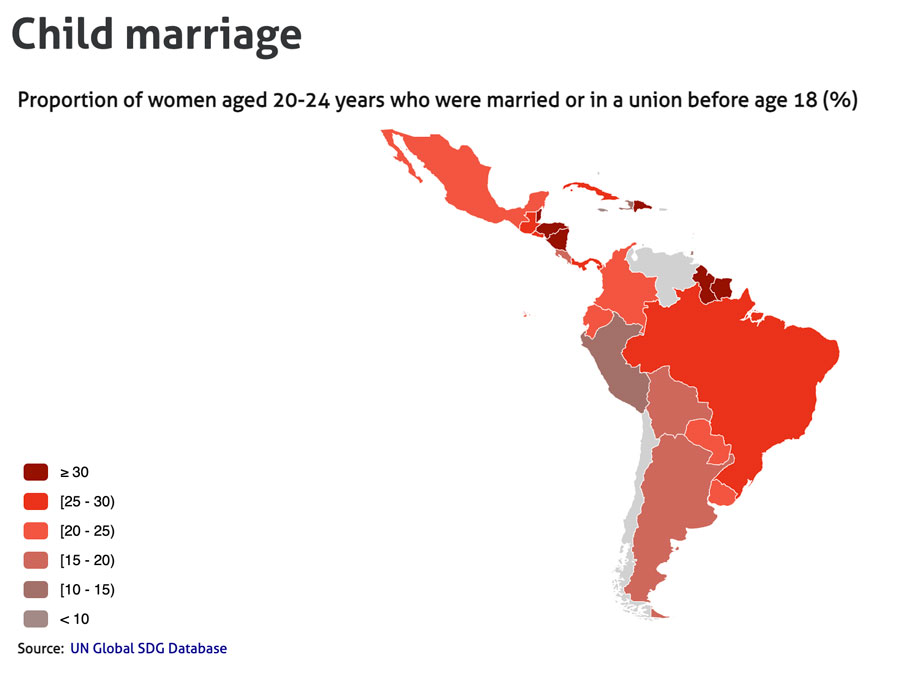
The child marriage indicator measures the proportion of women aged 20-24 who were married or in a stable union before turning 18. Child marriage is considered a violation of human rights and puts children, particularly girls, at risk of harm and limits their development. 

This harmful practice is associated with negative outcomes such as early childbearing, lower participation in the labour force as adults, lower education levels achieved, and a greater risk of experiencing gender-based violence.

The child marriage indicator is part of Sustainable Development Goal (SDG) 5, which aims to achieve gender equality and empower all women and girls by eliminating harmful practices such as child, early, and forced marriage and female genital mutilation. 

The analysis of the indicator reveals that in the region, one in five women is affected by child marriage, with the highest prevalence in Suriname, Nicaragua, Honduras, Belize, the Dominican Republic, and Guyana. However, there are some countries with lower percentages of child marriage, such as Costa Rica, Argentina, Peru, and Jamaica.

Image Source: United Nations


3. Teenage maternity

The indicator measures the percentage of young women aged 15 to 19 who have given birth to at least one child at the time of the census. This indicator is used to assess the prevalence of teenage pregnancy, which is considered a persistent problem in the region. 

Although the overall fertility rate in the region is declining, the rate of teenage maternity remains high and is one of the highest in the world, with Latin American and Caribbean countries having a teenage maternity rate of over 12%.

This rate is mainly composed of adolescents with lower incomes and lower levels of education, indicating that the problem disproportionately affects disadvantaged groups. 

Teenage pregnancy can have serious consequences for the health and well-being of young women, as well as for their social and economic opportunities, as they may face barriers to education, employment, and full participation in society.

Image Source: United Nations


4. Women’s deaths at the hands of their intimate partner or former partner

This indicator tells us the number and rate of women who are killed by their intimate partner or former partner. The data includes the absolute number and rate per 100,000 women aged 15 and over. This issue is a serious violation of women’s rights and a major public health concern in Latin America and the Caribbean. 

The Dominican Republic, Uruguay, and Honduras are the countries with the highest rates of women’s deaths at the hands of their intimate partner or former partner, with rates equal to or greater than 1.0 per 100,000 women. 

Guyana, Antigua and Barbuda, and Grenada have the highest rates of women’s deaths at the hands of their intimate partner or former partner in the Caribbean, while Jamaica has recorded the highest absolute number of victims. It is important to address this issue to ensure the safety and well-being of women in the region.

Image Source: United Nations

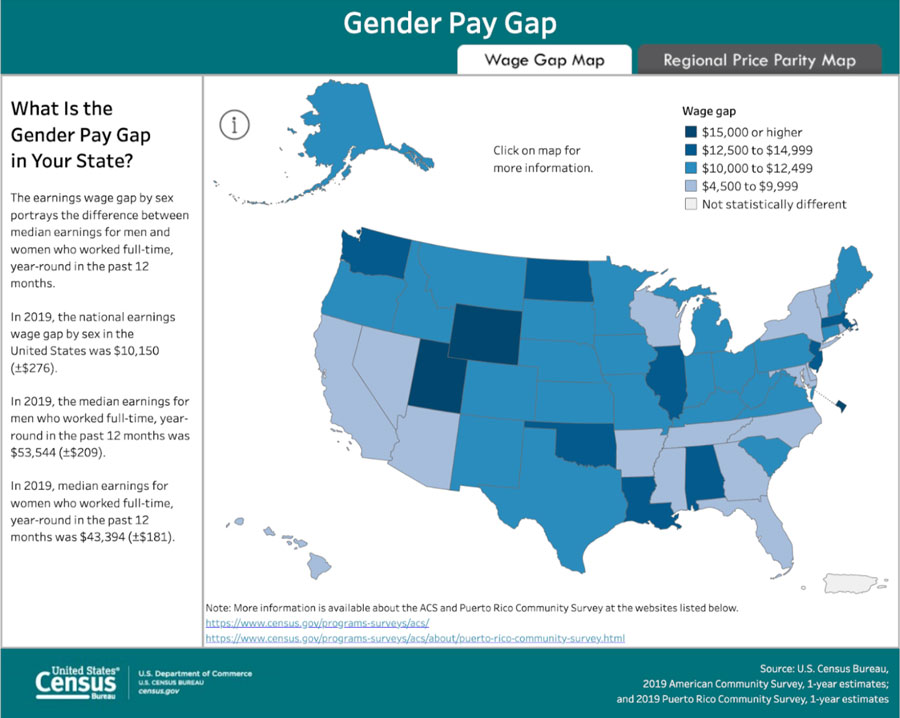
Women in the United States earn an average of 82% of what men earn, and the gender pay gap has remained relatively stable over the past 20 years. The wage gap is smaller for workers aged 25 to 34, where women earn 92 cents for every dollar earned by a man in the same age group. 

Women are overrepresented in lower-paying jobs relative to their share of the workforce, but their increasing presence in higher-paying jobs traditionally dominated by men has contributed to narrowing the gap. 

The reasons for the gender wage gap include women being treated differently by employers, women making different choices about how to balance work and family, and working in jobs that pay less. Working mothers are more likely to feel pressure to focus on responsibilities at home than working fathers.

Mothers are less likely to be in the labour force than women without children and, when employed, work fewer hours per week on average. Conversely, fathers are more likely to work longer hours and receive a “fatherhood wage premium,” which increases the gender pay gap. The pay gap also varies widely by race and ethnicity.

The gender pay gap has closed more among workers without a four-year college degree than among those who do have a bachelor’s degree or more education. Women have increased their share of employment in higher-paying occupations, such as managerial, business and finance, legal, and computer, science and engineering (STEM) occupations. 

However, women are still underrepresented in managerial and STEM occupations. Looking across racial and ethnic groups, a wide gulf separates the earnings of Black and Hispanic women from the earnings of White men.

Image Source: US Census Bureau

USA

Gender gap. How big is the gender gap in the digital tech industry, and how is it affecting the sector?

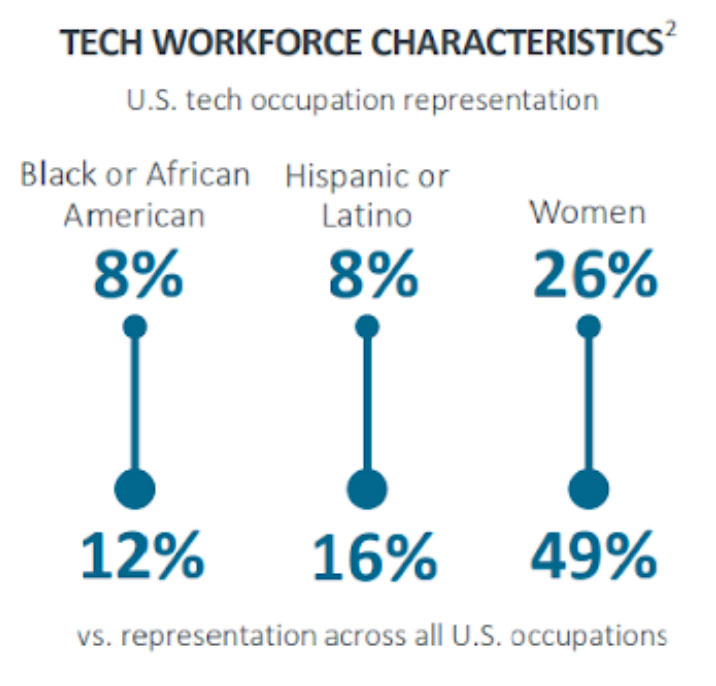
Diversity, equity and inclusion (DEI) is a concern in the US tech industry. Based on data from the U.S. Equal Employment Opportunity Commission (EEOC), compared to the total US workforce, the tech industry employs a smaller proportion of Black Americans (7.4% versus an average of 14,4%), Latinx Americans (8% versus 13.9%) and women (26% versus 49%).

Image Source: CompTIA Cyberstates 2022

The importance of an organisation’s reputation regarding DEI is gaining weight year-over-year due to a rise in social awareness. However critical social awareness may be to transform the industry, inclusion and diversity are also intelligent business choices: data proves that diverse companies are more likely to outperform their competitors financially.

Despite companies and governments making an effort to reduce the diversity gap, there’s still a long way to go, and there are many hurdles to overcome. According to The State of Diversity in Tech Report by Dice, perception of a lack of leadership opportunities and salary and benefit inequities are the most common causes of discrimination. In Dice’s report, 48% of participants in the study claim they feel that they are not fairly compensated compared to others in the same occupation with their same skill set. 

Focusing on gender as a factor of discrimination, women carry out only 26% of tech occupations, compared with 49% of women representing the total US workforce. This fact gives a general glimpse of the Gender Gap existing in the tech industry, where women are highly underrepresented. 

The Gender Gap influences a women’s tech career in an intersectional way. First, it’s essential to look at the number of women who choose a STEM (science, technology, engineering and mathematics) degree. Based on data from the Integrated Postsecondary Education Data System (IPEDS), women represented 45% of STEM majors in 2020. However, only 22% earned degrees in engineering and 20% in computer science. In the US, women’s limited access to STEM degrees is not a new phenomenon: a report titled “Why so few?” examines data from over two decades to understand the factors that can explain why women are systematically tracked away from science and math throughout their education. 

According to the American Association of University Women AAUW, study after study finds out that women have the ability and high test scores in STEM subjects, but even so, women are pushed away from these fields. They explain the underrepresentation is mainly because of structural and cultural barriers. Let’s take a closer look at the entry barriers women face in STEM:

  • There is a lack of female role models. Historically STEM fields have been male-dominated, which has created a taboo for women working as scientists and technologists. It’s like they don’t exist in the collective mental framework. The consequence of this lack of role models is that girls don’t have people like them to admire, which causes a lack of motivation and inspiration to pursue a career in STEM. Letting schoolgirls know they have a future in this industry is an important step forward. 

  • Stereotypes and sexism push girls away from STEM. Without any scientific basis, there’s an idea of women being less intelligent than men, primarily related to STEM subjects. This misconception significantly impacts girls’ self-image and determines their career aspirations through more “feminine” degrees.  A study by Wiley, reveals that 44% of the female respondents between 18 and 28 years were never given any information or resources to help them learn about tech career opportunities, compared with the 33% of males. 
  • STEM environment is hostile for women. Women who consider taking STEM subjects at school or having a related degree suffer from isolation and microaggressions, such as underestimating their opinions only for being a woman. These situations act as additional stressors that end up with many women dropping out of these lines because they feel they don’t fit in. 

Because of these obstacles, girls are less likely than boys to consider a career in technology. One of our Key Opinion Leaders, Ember., told us about their experience growing up in a male-dominated environment:

Soundbite:

my first computer class was AP Computer Science in Senior High School and already by then it was very male-dominated. My school was like very good and I definitely tried to get more girls and non-binary people into tech but Even by high school, it was seen as a boys thing. And honestly, I think that attitude actually probably starts elementary school, girls are not expected to be the ones hacking around or in Robotics club or even, you know, messing with more of the hardware stuff and that just continues all throughout. And by the time you’ve graduated, the number of women who’ve stuck it out and you have really like dealt with the microaggressions, dealt with the fact that sometimes You’re the only non guy in the class and the guys don’t know how to react to that. So they’re going to be creepy and of course, you know, 18, 19, 20 year old dudes who maybe don’t have social skills and Really don’t know how to deal with the fact that there’s a member of this foreign species in the class. But yeah. IT people and so it I think it’s just pipeline problem” .

Nevertheless, all kinds of organisations have launched action plans to empower women through STEM degrees and are reaping up their labour. Based on data from the National Science Foundation, more women than ever are earning STEM degrees and catching up to men.

Also, as more Gen Z women enter college and the workforce, we will see an increase in the percentage of females earning  STEM degrees and being interested in tech careers, as Gen Z is one of the first generations considered “digitally native”. 

Once students finish their degree, it’s time to get their foot in the door of the job market. Here women experience more difficulties being hired for entry-level technical positions. This phenomenon is known as the retention gap. One example of this gap is that only 38% of women who majored in computer science are working in the field, compared to 53% of men – this happens at a similar rate with engineering degrees.

Regarding under-represented minority groups, they represented about 9% of the nation’s top computer science programs, but large tech firms employed only 5%. The lack of employment diversity in the tech industry has often been attributed to a lack of applicant diversity and self-selection of minorities away from STEM fields. However, this argument denies the responsibility of employers to hire and retain talent. 

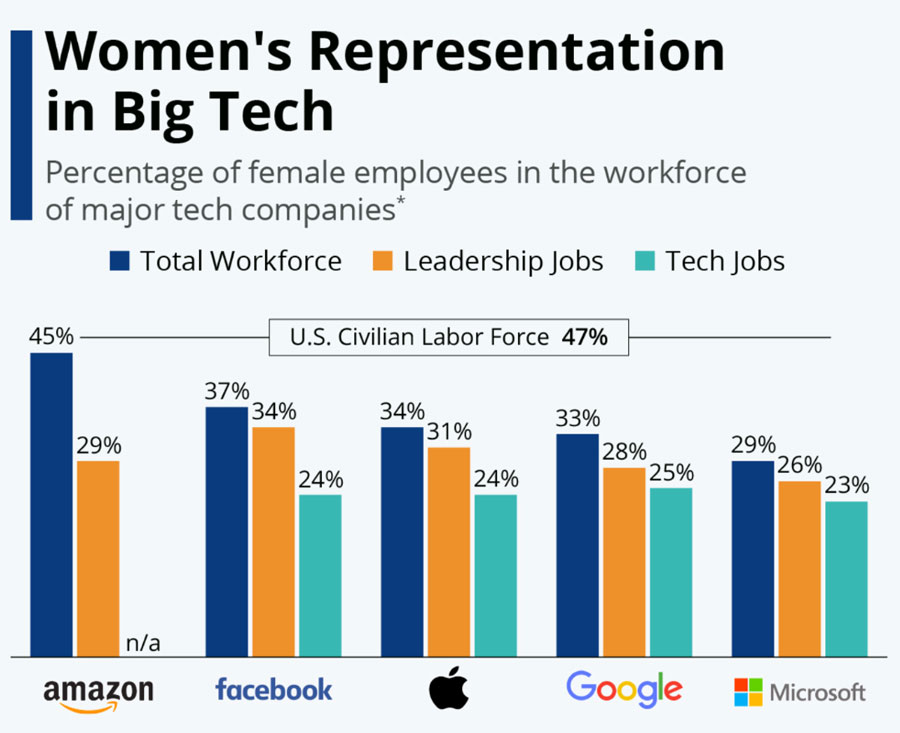
Image Source: Statista

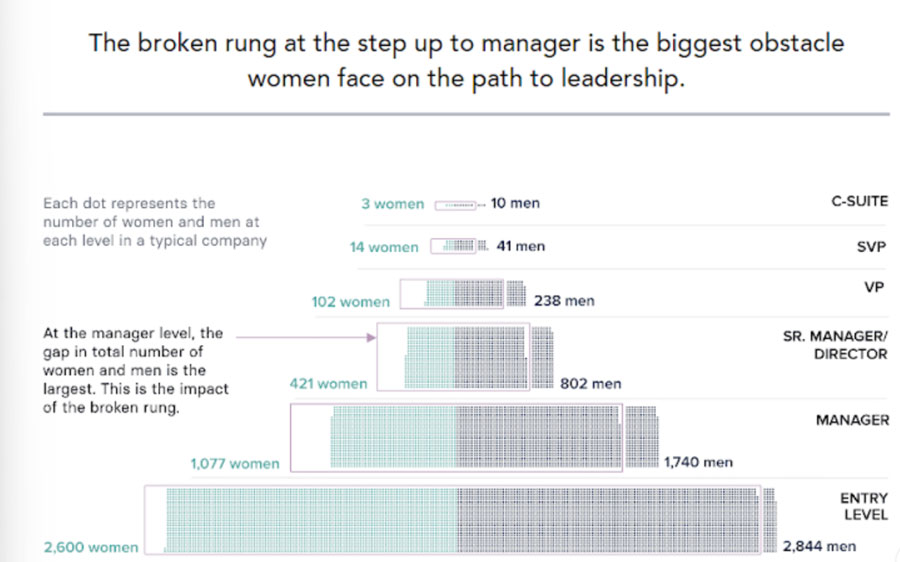
After getting past the hiring hurdles, women face another challenge in their professional careers: the glass ceiling. This metaphorical invisible barrier hinders women and minorities from advancing in a profession. A fact that reinforces this barrier is that 66% of women state that they see no clear path for advancement or improvement within their tech careers. For many women, it comes to a stage when their careers come to a standstill. The data provided by McKinsey & Company shows that while 48% of women account for entry-level hires, they just account for 40% of first-level managers. This bottleneck continues to increase as it gets higher in the corporate rank, as shown in the image below.

Image Source: Leanin

For Black women and Latinas, this broken rung is even more decisive.

According to Leanin, for every 100 entry-level men who are promoted to manager, just 68 Latinas and 58 Black women are promoted; this number is even lower for Native Hawaiian, Pacific Islander, and Indigenous women. Also, people with disabilities face more barriers to advancement and get less support from their managers. 

This glass ceiling, called the broken rung, connects directly with wage inequalities.

On average, women in the tech industry are offered a salary of 3% less than men for the same job, at the same company, with the same experience. 

Another important piece of data is that women are more likely to leave their companies, according to the McKinsey Report on Women in the Workplace. This study points to an unfavourable environment for women inside companies, summed up by the barriers they already face to achieve being there. 

In this  Wiley report, 68% of participants surveyed claim they have felt uncomfortable at a job due to their gender, ethnicity, socio-economic background or neurodevelopmental condition. Moreover, 50% wanted to leave a tech job because the company culture made them uncomfortable. Because of this, the option of working remotely is essential to women. The possibility of hybrid and remote work has delivered tangible benefits for many women, making work and life balance much more effortless. 

The Women Tech Network predicts that at the current pace of change, it will take 133 years until the gender gap is closed. Companies need to take action and implement programs to improve their DEI policies to build a stronger industry. According to McKinsey & Company, “diversity is especially crucial in these roles to help debias the technologies that make up an ever-present evolving component of modern life”. Counting with employees of different backgrounds, experiences, and ideas helps to breed higher quality products. 

Women entrepreneurs in the US face many challenges of their own, and according to a report by The Silicon Valley Bank, more than half of the country’s startups lack women on their boards. Only 14% of startups have a female CEO, and if the startup founder is a man, it’s less likely to have a woman in the COO role or leading HR marketinentrepreneurseams. Unfortunately, female founders are slightly less likely to rely on VC and more so on friends and family. 

What is this study about?

Ironhack is the second biggest school in the world, with more than 10.000 students. They have 10 campuses and since Covid, have started an online teaching program. They are specialized on digital technologies, and their main focus is to reduce the gap between supply of workforce and the demand of the companies.

From 2023 on, they want to start publishing reports to position themselves as thought leaders in tech areas. They have contacted us to help them build this reports. We’ll start building the State of Tech in 2023 report, to be ready this January. If the relationship goes on, they will need another report on september.

IRONHACK wants to use this report as a source of knowledge to build “hero content” for their communication channels throughout the year.

Thanks to this efforts, they expect to:

  1. Drive brand awareness online.
  2. Establish their brand as thought leader in the tech industry recruitment space.
  3. To show how well they understand the skills gap in the sector.
  4. To gain more lead for the top of the funnel.
  5. To drive more traffic to their website.
  6. To nurture their funnel, resulting in more apps.

Audience of the contents of this report:

  1. B2C: Career changers and recent grads, looking to understand the viability of a career in tech, the long term benefits of getting into tech and what kind of jobs are out there in 2023. They should come away from reading the report feeling motivated to get into tech, with an idea of what job they want and how to get it.

  2. B2B: Hiring managers and recruiters, looking to understand the skills and current pools currently available in the market. They should come away from reading the report feeling more certain of the kinds of profiles they should be looking for.

The study includes: 

  • 9 Reports on the State of Digital Tech 2023, in 9 countries. 
  • 1 Global Report on the State of Digital Tech 2023. 
  • 1 light Gender Report.
  • 1 Global Survey about the State of Digital Tech 2023.
  • 109 Interviews

Interviews: 

  • 9 Ironhack Local Outcome Managers
  • 9 Gender Experts
  • 18 Ironhack Students
  • 18 Key Opinion Leaders (KOL)
  • 27 Chiefs
  • 27 Career Changers

Discover more about this study in the Research Proposal

Chose your country

Europe

New!

America

Europe

UK

PO

FR

NL

GM

SP

America

The Survey

The Survey was intended to be delivered in for this research through LinkedIn Ads, but after designing the campaigns and test-launching it, we noticed bad results in terms of Survey submissions. 

The Survey strategy is being rethought at the moment. 

You can access the ongoing Survey here.