Welcome to the

State of Tech 23 | PORTUGAL

What you'll find out

Digital Technology Vision in the Portugal

Digitalization: the roadmap to innovation and technology

In recent years, Portugal has shifted its approach to digitalisation. This change in direction is driven by a number of factors, one of the most significant being the government’s increasing emphasis on digital growth. The Portuguese government recognises the potential of digitalisation to drive economic growth and improve the efficiency and effectiveness of public services. Additionally, as the world becomes increasingly digital, the government sees digitalisation as a way to ensure that Portugal remains competitive on the global stage. 

Portugal is actively working to create an environment that supports the growth and development of the digital industry. 

The Council of Ministers of Portugal has approved the Action Plan for Digital Transition, laying out the strategy for the country’s digitalisation. The Portugal Digital Mission Structure is responsible for overseeing the implementation of the Action Plan and ensuring coordination with other relevant structures. It also tracks progress and reports results, promoting the plan nationally and internationally. The structure is committed to achieving the strategic objectives outlined in the plan and is actively working towards its success.

Portugal was already taking steps towards a new digital age, but the COVID-19 pandemic created the perfect breeding ground for this acceleration.

The economic and public health crisis generated by the pandemic significantly impacted the acceleration of this digital transition, as social forms changed to favour confinement and, as a result, the use of technology became an essential everyday tool. 

“While 14% of executives report the pandemic is continuing to disrupt their organization’s business plans and operations, another 86% report that their organization has adapted to the disruption of the pandemic and has found a new normal”. Accenture Technology Vision 2022.

A newcomer startup hub

Portugal’s startup scene has been gaining traction since 2017 and has also favoured the development and speed of digitisation, innovation, and technology. Portugal understood the opportunity to attract more investment by creating a competitive environment, understanding its core competencies, and making an action plan to work on growth opportunities. According to The Business Year 22 Portugal, there are 7 Portuguese unicorn companies; those are the ones valued at more than the 1 billion mark.

The startup scene is growing, and the country’s efforts in creating a healthy ecosystem for new companies seem to be paying off, and though it’s still a young market, it’s proving diverse and growth-oriented. This map represents diversity in sectors and industries in the startup scene during 2021: 
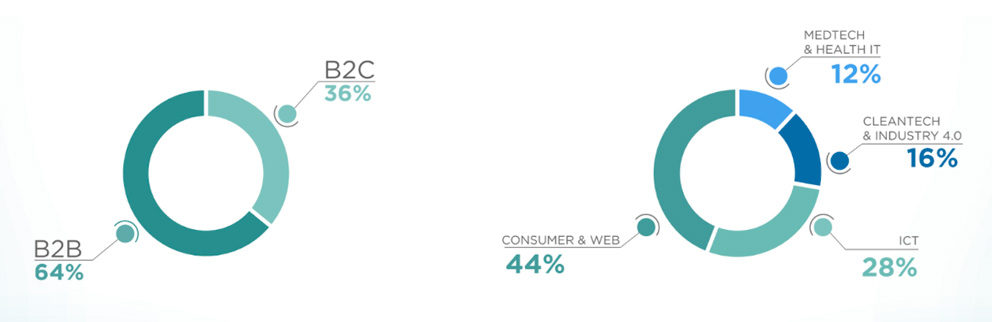
Startup and Entrepreneurial Ecosystem 2022. Report 2021.

In collaboration with private initiatives, the Agency for Competitiveness and Innovation (IAPMEI), Startup Portugal, and the Republic of Portugal are creating a solid environment for start-ups to grow in. 

A critical factor that helps place Portugal on the startup maps is its strategic location, with good communications and flights to Asia and America, zero tax on cryptocurrency, high-speed connectivity, interesting tax programmes and the country’s Non-Habitual Residency Tax Regime

Portuguese taxes are at a flat 20%, and foreigners that bring their pensions to Portugal are taxed at a flat 10%. Other social and cultural factors that are also having a positive impact on the country’s startup growth: a low cost of living, compared to other European cities, good quality of life and being a trendy destination have made Portugal and -especially its capital Lisbon-, one of the biggest international hubs attracting not only techies but also digital nomads, and other tech-related profiles.

Lisbon’s startup ecosystem is proving fertile, and a new generation of Portuguese founder talent is developing in the city. The Lisbon scene alone accounts for over 60% of Portugal’s tech value. In 2022, Lisbon startups raised €309M in VC investment, which doubled the investment from 2021, with food, health and fintech leading the ecosystem by the number of funding rounds.  Lisbon has 1,520 technology companies representing 32% of the national market and is followed by Porto, which means 19% of the market with 875 tech companies

Portugal, overall, is becoming increasingly digital. According to ACEPI, a leading organisation working to accelerate the country’s digital transformation since 2000, Internet usage continues to grow. It is now almost matched to Europe’s average usage. In 2022, 85% of Portugal used the internet compared to the 93% European average.

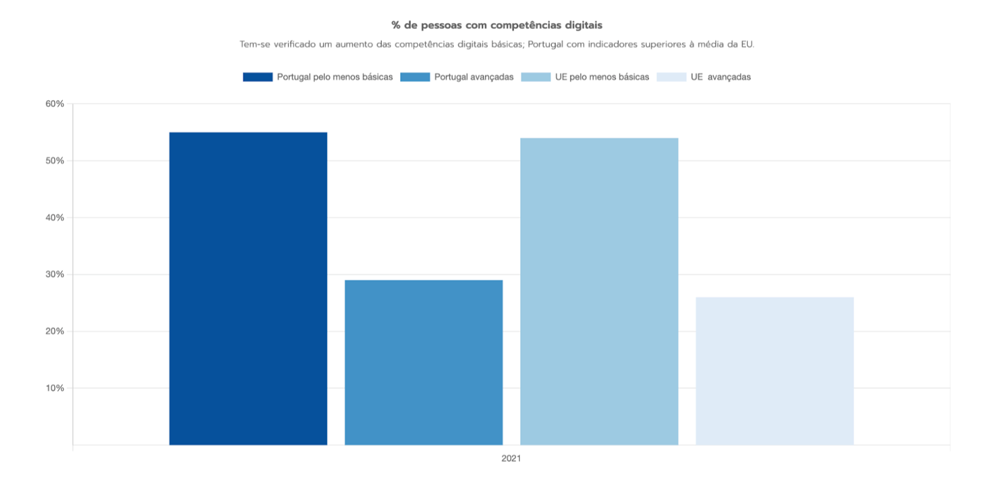
Internet penetration is also observable in the number of people with essential and advanced digital skills

Portugal: catching up with Europe’s performance

The Digital Economy and Society Index (DESI) measures digitalisation variables and European countries’ digital performances and is often used as a measuring tool to understand how European economies are evolving and adapting.

In the 2022 DESI, Portugal scored 50.8, almost 2 points below the average in UE (52.3). 

Of the 27 European countries, Portugal ranked in the 15th position: 
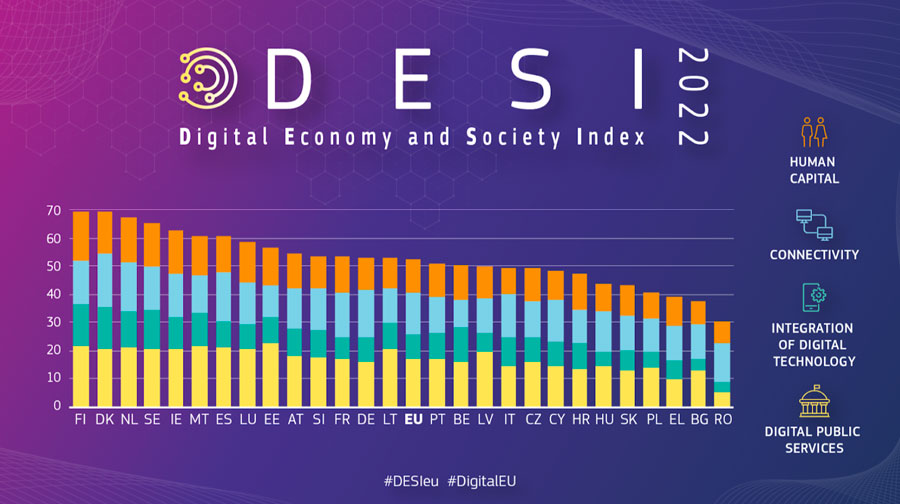
The 2022 DESI Portugal report highlights the county’s efforts to expand connectivity, equipping its population with digital skills and supporting companies’ technology adoption. It also notes how public administrations are transforming their public services thanks to sustained digitalisation efforts. Portugal’s regulatory framework is laying the groundwork for public administration simplification and digitalisation while ensuring data protection, cybersecurity and public participation. 

The Portuguese government knows that the country must continue to improve its performance to reach a better position amongst its European neighbours and to match the European 2030 targets and objectives in the Path to Digital Decade programme, which aims to guide Europe’s digital transformation

The government is making a conscious effort to continue planning and designing its next steps and sharing its vision through guides and policies. The Digital Transition Action Plan (DTPA) is one of these guides, and it serves as a roadmap that helps define Portugal’s strategy for the coming years. 

Another example of Portugal’s efforts in digital transformation is a government-created platform called Portugal Digital.

It exists to implement actions and strategies from the DTPA, such as courses, assessing and accelerating businesses, promoting digital public services and promoting Portugal as an international digital newcomer. 

This platform supports the nation’s digital transformation by considering three dimensions: human resources (training and digital inclusion), companies (corporative digital transformation), and digitalization of public administration. 

According to the European Innovation Scoreboard 2022, Portugal is considered a Moderate Innovator with 85.8% of the EU average performance. Over the last six years, Portugal’s performance has increased by 6.4%, but compared to Europe’s average increase (9.9%) indicates that there is still a significant gap between Portugal’s performance and the average European country.  This scoreboard shows that Portugal still has room for improvement. 
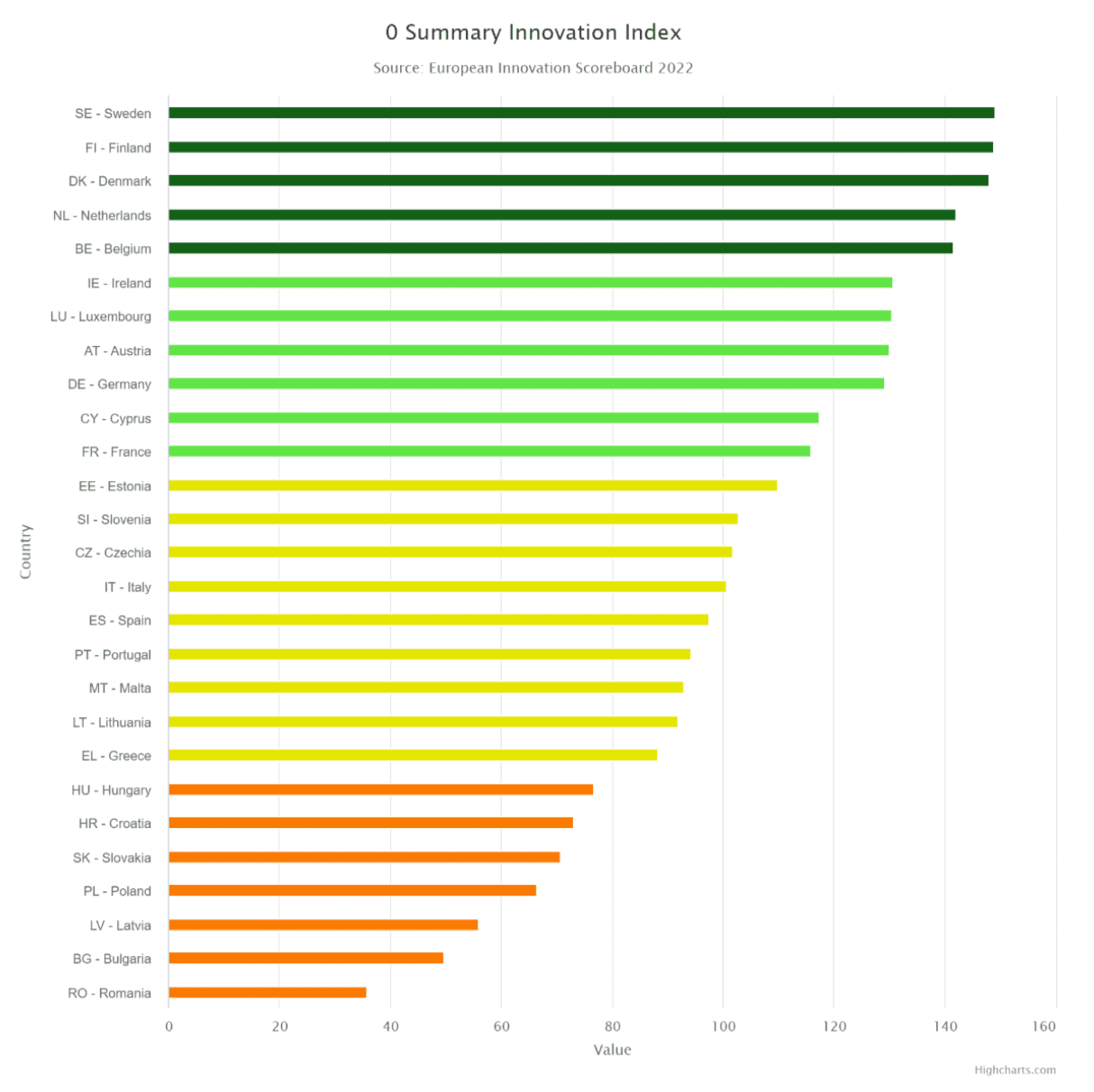
European Innovation Scoreboard 2022

Workplace gap: existing problem between supply and demand in digital technology

Portugal’s job market is evolving at the same speed as the tech industry changes and grows. One of the most significant consequences of the acceleration of digitisation is that tech companies (mature ones and newcomers) are consequently increasing the demand for technical and non-technical profiles. 

In 2023 Portugal’s IT job market is expected to grow by 33%, and predictions only seem to point out continuous growth. In 2020, 120.000 people worked in the tech industry, which jumped to 160.000 in 2022.  

The widespread use of remote work has eliminated many geographical and cultural barriers, enabling tech professionals in Portugal to work for local and international companies. As a result, foreign companies have been actively recruiting Portuguese tech talent to work remotely from Portugal. Currently, 18.6% of tech professionals in Portugal work remotely for a company across borders. What’s more, Portuguese tech professionals who work abroad earn, on average, 33% more than the ones working for Portuguese companies.

According to a Landing.Jobs report, however, the Portuguese tech scene is not so comfortable hiring talent from outside the country. Despite some wonderful initiatives to drive in foreign talent, like this Digital Nomad Village, Portuguese companies hire mainly local talent, and data in the report shows that  8.9% of the Portuguese workforce comes from other countries, compared to an average of 12% in Europe and 38% in North America. This situation is undoubtedly exacerbating the shortage for local firms.

This is becoming an issue, as hiring tech talent from abroad could help alleviate the pressures of a heavily imbalanced market. According to data by ManPorwerGroup85% of Portuguese employers find it difficult to fill their vacancies, especially in large and medium-sized companies. Portugal’s talent shortage is extreme and seriously threatens the country’s economic and technological growth

According to research conducted by Caixa Bank, vacancies in ICT show very high year-on-year growth and already exceed pre-pandemic levels. One potential explanation for this trend is the disconnect between the skillset required by companies and the qualifications of job candidates. This mismatch may contribute to the growing number of unfilled positions in the information and communication technology industries. The shortage of skilled workers in these areas is particularly concerning, as the COVID-19 pandemic has led to a surge in remote work and an increased reliance on digital services, raising the demand for workers with digital expertise.

The drop in immigration may also contribute to the current labour market situation. The number of permanent migrants, which had been rising since 2015, saw a significant decrease in 2020. This, along with a reduction in the foreign labour force, may have impacted the availability of skilled workers in specific industries. 

A strategy that could help boost Portugal’s talent pool is to increase digital skills across the nation, helping people who are already in the job market and people who haven’t entered yet to gain the skills they need in order to be employable in the future. The Portugal Digital Skills and Jobs Coalition, led by the INCoDe.2030 Program, is an initiative that world towards this goal. It was created in 2015 in response to the European Commission’s call to address the digital skills shortage in Portugal and improve employability within the tech industry. The Coalition was re-launched in 2021 and currently comprises 37 organisations, including government agencies, public institutions, private companies, associations, non-profits, universities, and industry groups. 

The Digital Skills and Jobs Coalition identified the need to develop digital skills in four main clusters:

  1. Digital skills for all 
  2. Digital skills in education
  3. Digital skills for the workforce
  4. Digital skills for ICT professionals

From government to private enterprises, NGOs, and training centres, they have all joined forces trying to create innovative training accessible for young people in ICT, offering flexible training systems and digital skills certifications, and raising awareness of opportunities in the sector. The government knows that talent training is one of the most significant weaknesses of the tech sector, and it cannot grow if there is no talent to support it. This is why one of Portugal’s digitization plan priorities is including training as one of their main lines of action. 

The most in-demand roles in the country are developers, according to landing.jobs in their Tech Careers Report 2021; in 2021, Full-stack, Back-end, or Front-end positions represented almost 50% of the tech vacancies. 

Leadership and project management skills-oriented roles were next on the list, representing 25% of the overall vacancies, followed by other tech positions such as Technical Team Leader, Project Manager, Product Owner/Product Manager, and Scrum Master.

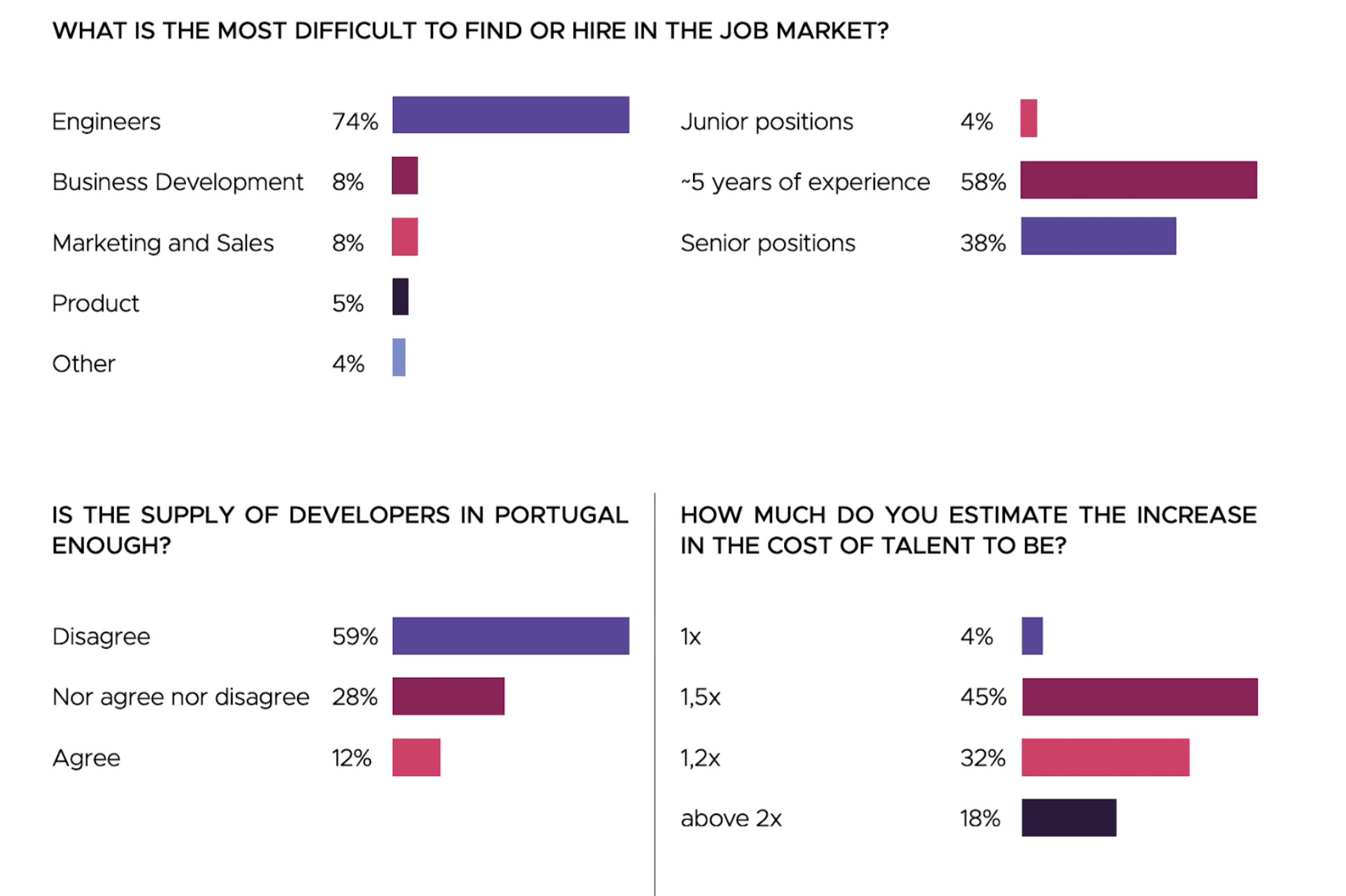
According to the Fintech Report 2022, the most complex positions to fill are engineers, and the supply of developers in Portugal doesn’t meet the demand. The survey also predicts the cost of roles will increase by 1.5x. 
 

The most frequent vacancies in Portuguese jobs platforms such as EVPConnect, ITjobs or Expresso Emprego are looking for people with knowledge and experience in IT, preferably with Computer Engineering or similar IT background with a good level of English, good software management skills (Microsoft, Linux, SQL, and Azure are frequently requested). This map, by Landing.jobs, shows more in-demand roles in Portugal: 
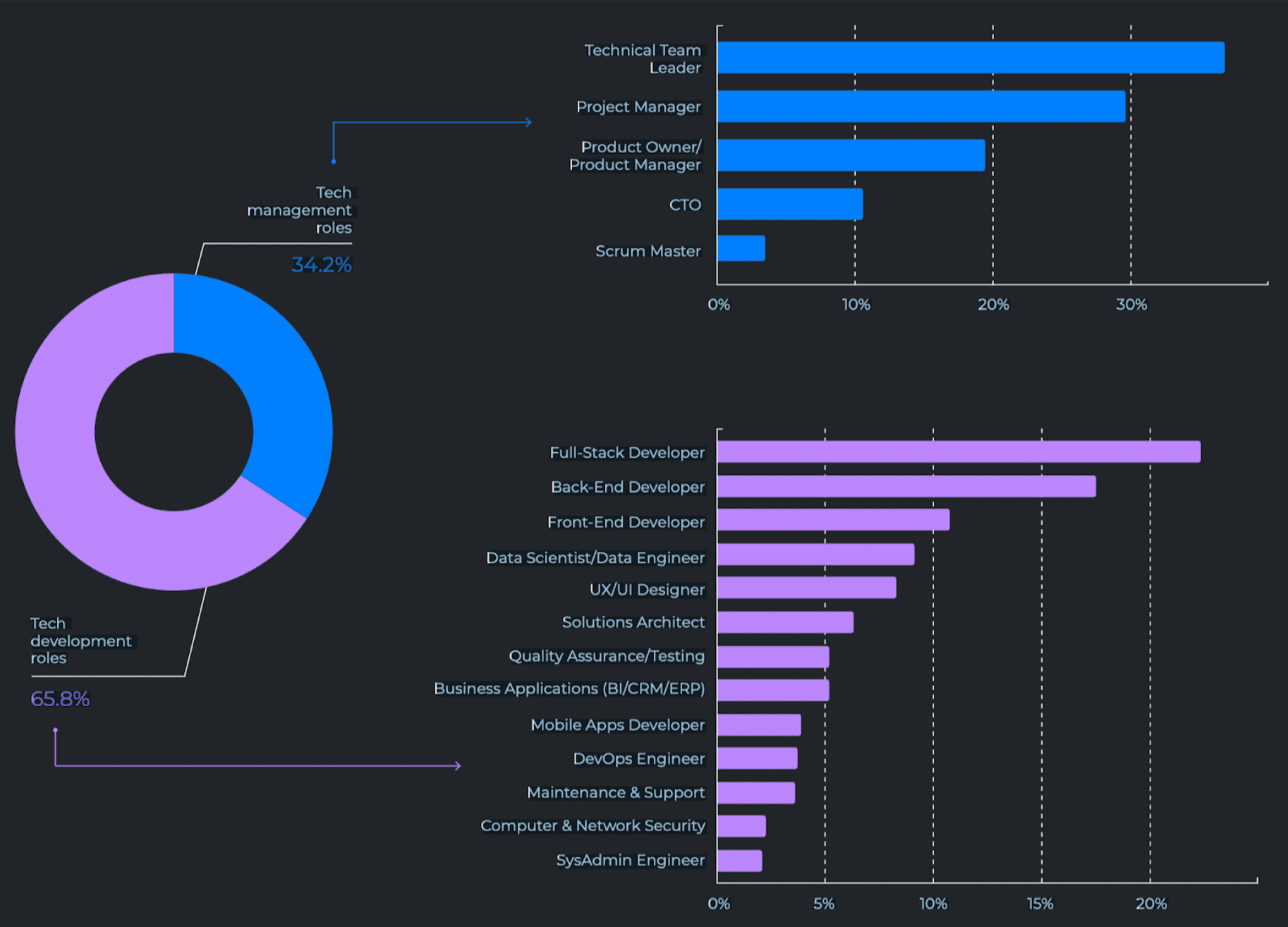
 

Deep Dive into the Portuguese Tech Market 2022. 

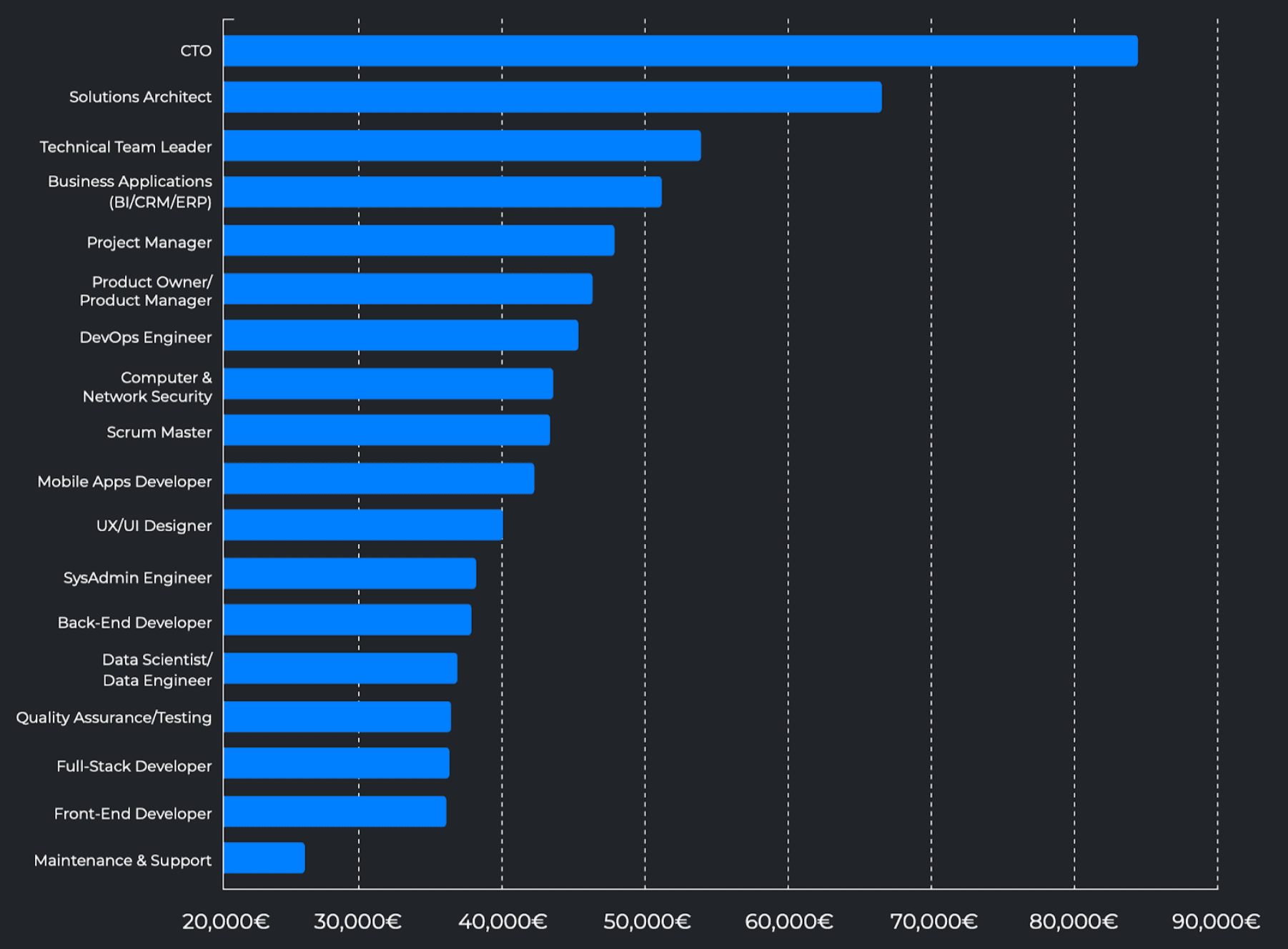
Salaries in Portugal are lower than in neighbouring countries, but tech jobs are, at the same time, among the best paid in Portugal. The average annual salary for tech professionals is around 32.500€. You can expect to earn around 18,4% more in Lisbon than in other areas of the country

According to Adecco, salaries for developers and analysts can range from 30.000€ to 40.000€. Different IT positions are highly coveted; for example, Cybersecurity specialists can earn up to 60,000€.

Many companies based in Portugal are observing the talent shortage and adapting to it. The first action they can implement to help alleviate the shortage pressure is to include talent training as part of the strategy. Companies that have recently landed in the country, such as Uber or Revolut, as well as others more established, such as Fujitsu, Microsoft or Siemens, are starting to create international competence centres where services and innovation are fostered. The idea is to boost knowledge and give continuity to their operations, and in some cases, to train talent and then incorporate them into their workforce.

Critical Techworks, an innovation centre that emerged from the partnership between Portuguese Critical Software and BMW, has training initiatives in areas of specialisation such as cybersecurity, cloud infrastructure, and java full-stack. Their idea is to attract talent, improve their qualifications and grow a talent network.

In addition to professional training, other strategies have been created to supply the demand for talent in Portugal and to increase its retention. According to the specialised firm sapo.pt, remote work and external talent can be solutions that help fill the market. 

An outcome of the COVID-19 pandemic is the experience of remote work and other forms of team relocation, and workers continue to expect employers to provide flexible work spaces. The remote and hybrid hiring models have become fundamental for talent attraction and retention.

Offering attractive working models is crucial to attracting talent coming from other countries, retaining national talent and decreasing job-to-job hopping.

Gender gap. How big is the gender gap in the digital tech industry, and how is it affecting the sector​

Portugal’s tech industry is becoming a more favourable environment for women in technology. Data from the job platform Honeypot shows that the pay gap for women in technology in Portugal is smaller than the overall gender pay gap in the country. This means that for women, pursuing a career in technology in Portugal is less financially risky than in other countries. 

The tech industry has a well-documented issue with gender inequality, including a lack of representation of women in leadership positions and a gender pay gap, so despite Portugal’s leading role in female tech, there are still many systemic industry-level biases that we need to reduce in order to reach true equality. 

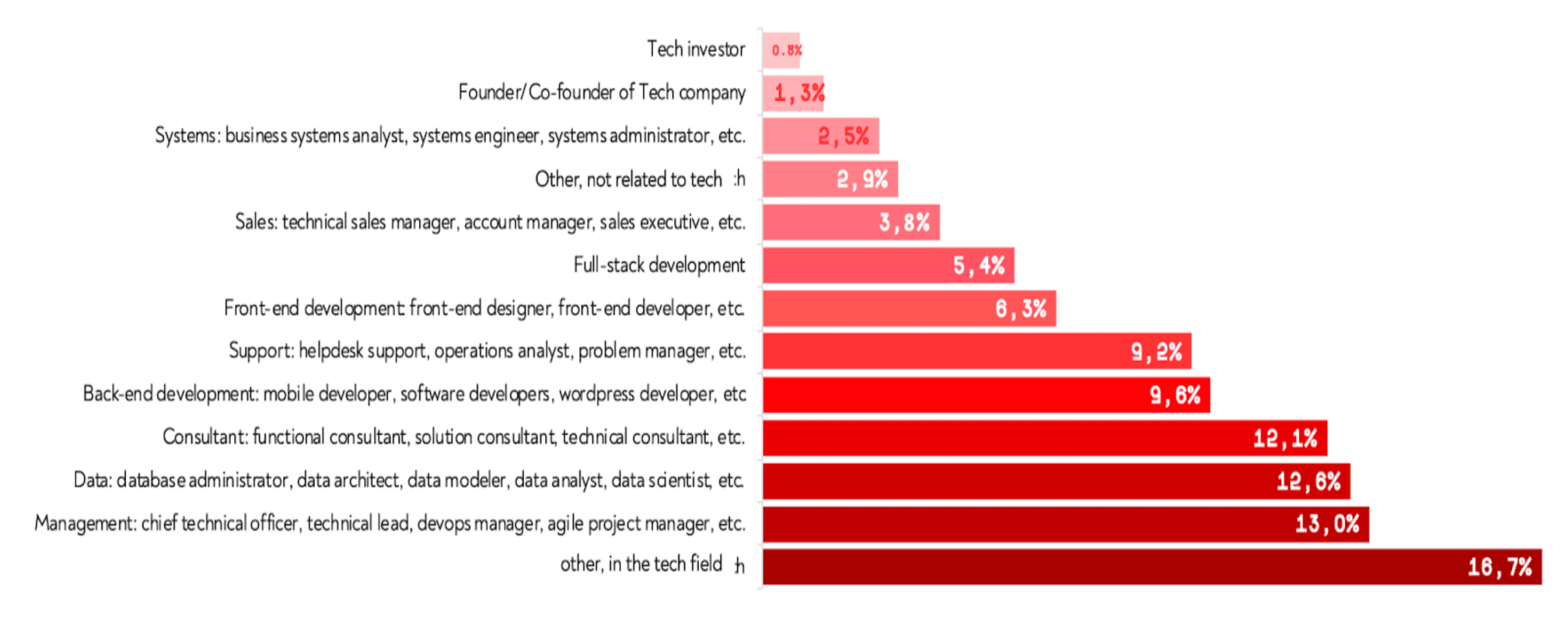
Pioneers, a study conducted by Portuguese Women in Tech, looked at Portugal’s tech scene from a female perspective. According to the research, most Portuguese women in the industry work in management-related roles (13%), data-related roles (12%), or consulting (12%). Only 0.8% are tech investors, and only 1% are founders or co-founders of tech companies. 

Most of them earn a monthly salary between 1,000 and 1,499 euro, and 45% of respondents stated that a slow salary progression and low chances of career progression is the main reasons they consider leaving their jobs.

Ines Santos, a Portuguese Women in Technology co-founder, talks about how there is still a long way to go before parity is achieved, and the situation of women working in technology is not ideal.

Soundbite:

“you need to be aware even a lot of people think that things are getting better but that’s not necessarily the case. Within terms of percentage, it was the case, So right now in Portugal, the latest data that I have is like 14. I think it’s 14.4% of the professionals in it. I think it’s 14.4% of the professionals in it. ”

According to a Landing.jobs 2022 report, women’s representativeness has increased from 12.5% in 2021 to 18% in 2022. Although positive, the data still shows a significant imbalance in the tech scene. This chart shows gender distribution in Portugal’s tech companies:
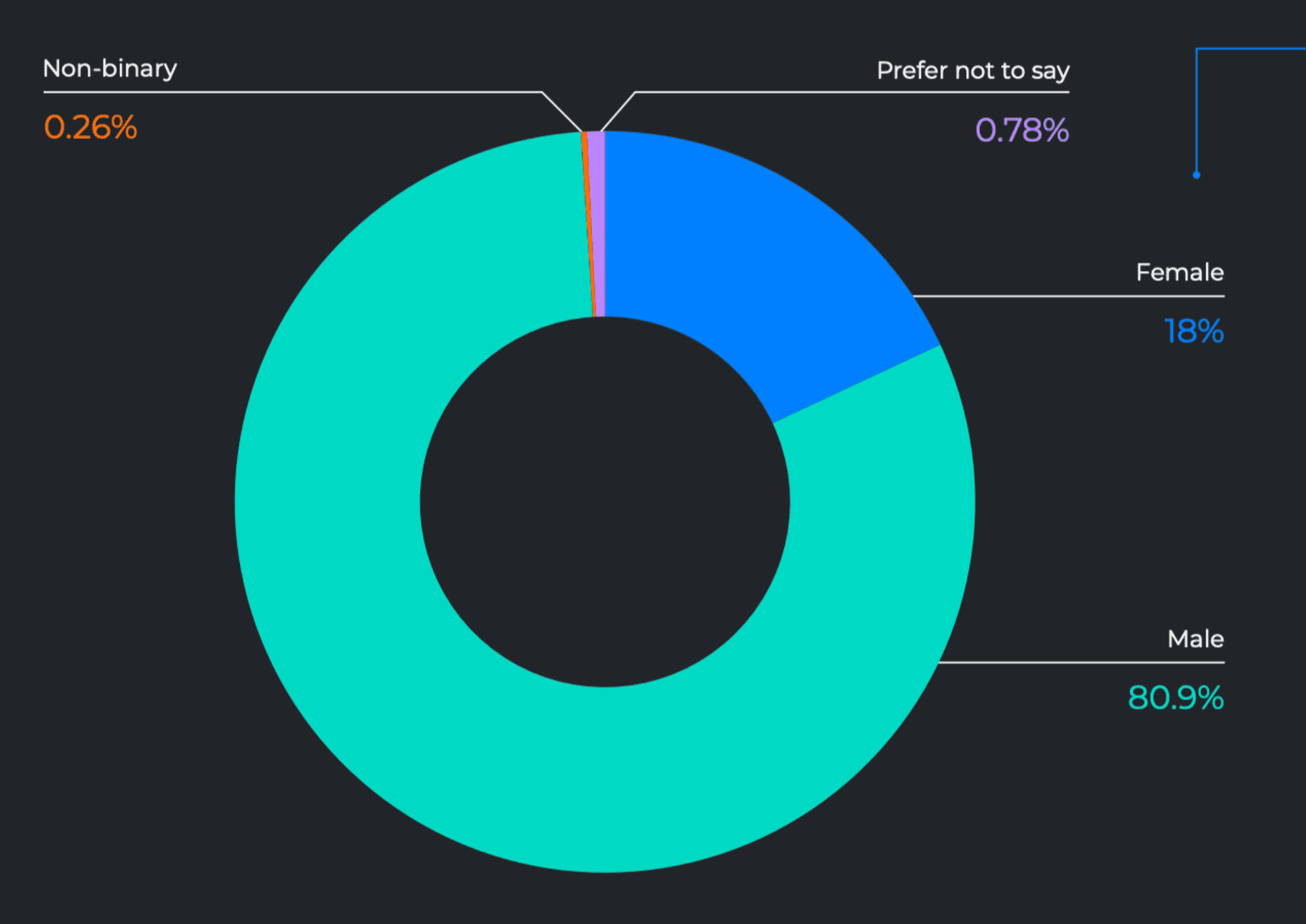
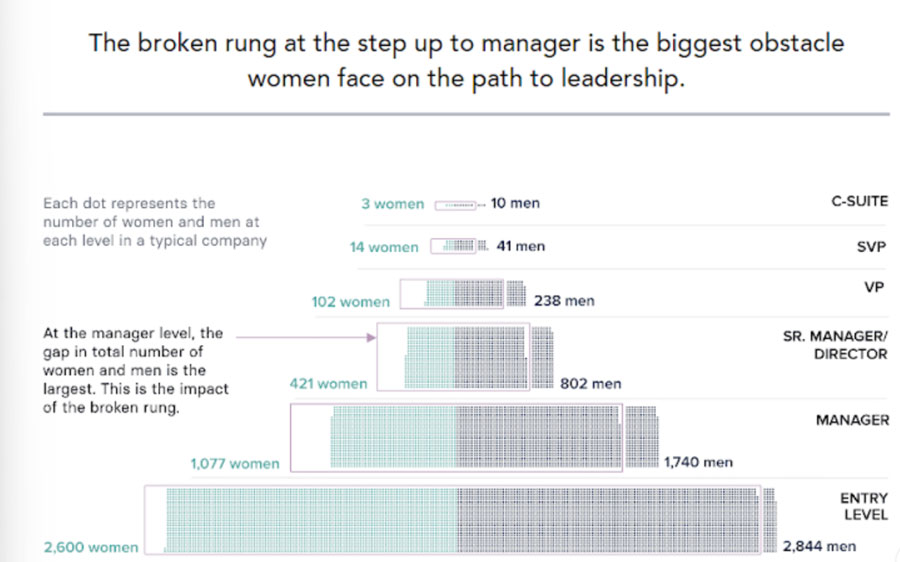
This gender imbalance is not just an issue that affects the technology industry; it is a social and cultural concern that starts long before people enter the workforce. 

In Portugal, according to the OECD, women already account for 57% of all students attending higher education in the so-called STEM (Science, Technology, Engineering and Mathematics) courses. The number decreases as the courses become more specialised. 

Regarding education, Ines Santos says:

Soundbite:

«we don’t see a lot of girls going to or pursuing, like a tech university, the degree. Because and I think the reason is that they don’t understand what actually means or what it is to work in technology«.

She also points out the importance of role models and how close they can be to inspiring us to pursue technology careers:

«what it means to work in technology impact that can technology can have because I think we can have a very positive influence. On them. And I think parents also need to be really aware of like the opportunities of the job market… we need to provide as much information as possible, so they can have, then have made the best decisions….»

This graph 35 maps out the representation issue in the industry and notes that the less one feels they are being represented, the more they feel the environment isn’t inclusive. This leads to a lack of integration and feelings of not belonging: 
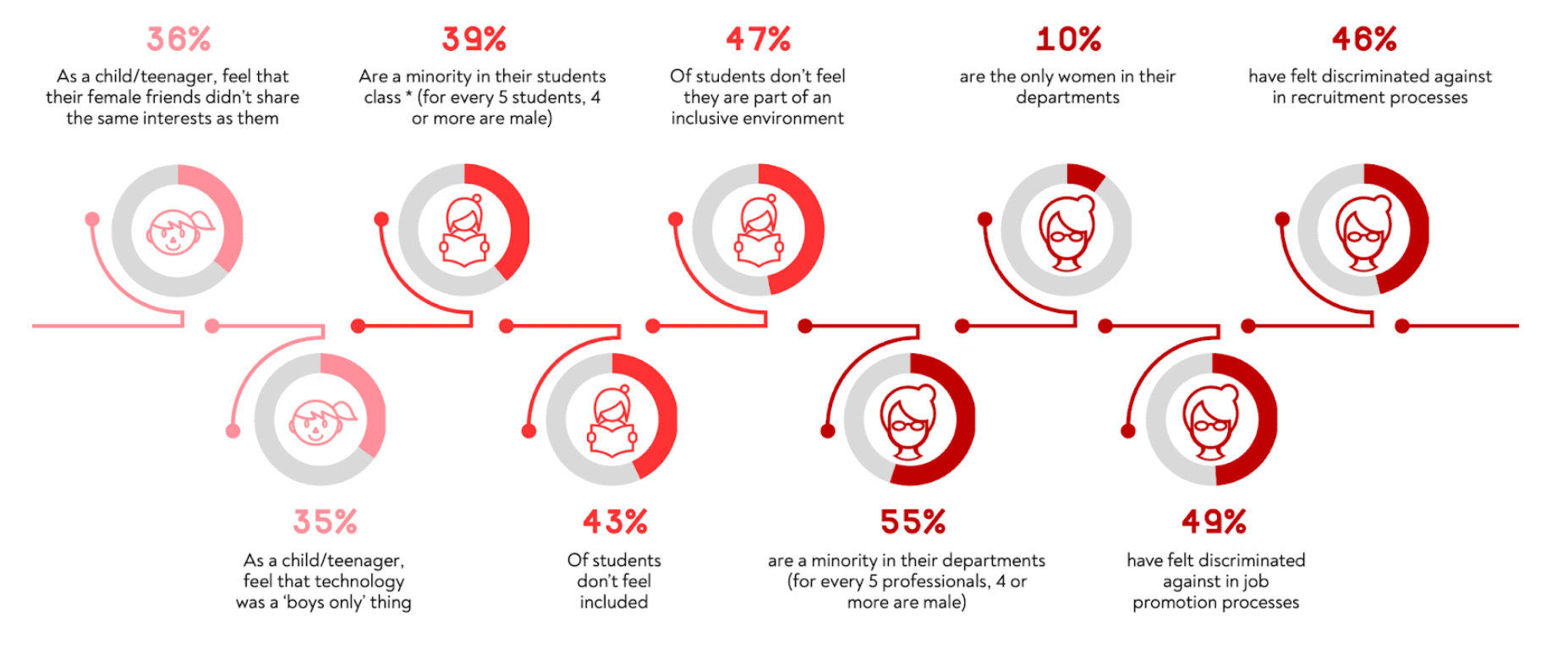
The problem seems to be not only in the area of inclusion or lack of industry knowledge as part of the socially learned barriers of expectations of where women should be. Within the industry, other barriers slow down their career development, all of which are related to a lack of representation and the feeling of not belonging. In Pioneers, 55% of respondents said they work in departments with only 2 women or fewer for every 10 men, and 10% of the workers are the only women in their departments. 

In the same way, the study points out that 47% of students don’t feel they are part of an inclusive environment, and many of the study respondents reported feeling unrepresented and discriminated against in a recruitment or promotion process. Reaching almost half of the sample surveyed, 49% have felt discriminated against in job promotion processes. 

In the following graph, we can see a list, in ascending order, of the positions in which women are most represented in the tech labour market. Women are represented in many roles, with a higher percentage in leadership positions, at 13%. This is followed by data and consulting roles, with around 12%. While 13% of the surveyed population are in leadership positions, the remaining percentage does not work in leading teams or managing people.
To face these challenges, Portuguese Women in Tech is working hard to educate girls, women and the general population in tech, diversity and equality. Some of their actions are at a corporate level, working to ensure that awareness of gender equality spreads and helping companies realise they must consider inclusion and diversity in their selection processes.

Soundbite:

«We are also working with technology companies to really help them to be more diverse and inclusive. I think they can go a long way right now. They’re much more aware of what’s going on. And they’re doing like intentionally creating initiatives to really, and to try to understand how to make sure that everybody feels welcome.” 

Their goal is to inform companies about discrimination and lack of representation in order to help close the gender gap and also organise actions to deal with day-to-day issues that can detract from an inclusive and comfortable environment for all workers.

Soundbite:

«create mentoring and sponsorship programmes to really support women so that they are like they are inside the company and make sure they advance in their careers. And a third thing is, really make sure that the hiring processes are not biased …. change the job offers, women only apply to one job offer. If they have 100% of the skills, many men applied. Apply, if they have 40% of the skills, and, from talking to a lot of tech companies, I know a lot of the times what happens is like they try to hire unicorns, but they don’t exist, but what it means is that women don’t apply for that job. The work is not only in terms of inclusion and dissemination, there is also a lot to be done in terms of training female talent…»

Another of the most significant issues to deal with before we can close the gender gap in tech is understanding the gap in salaries. Men still earn 16% more than women in tech jobs, and Portuguese Women in tech have different initiatives to promote the reduction of the gender gap in terms of wages. The most notorious one is the PWIT Salary Transparency Project, a community-driven database that offers nonfiction video professionals timely insight into constantly evolving hiring trends and pay parity practices.

The main takeaway to understand when discussing the gender gap is that it’s not a women-only problem; it results in a lack of diversity in the workforce. The gender gap is a systemic issue that must be addressed from many different angles: private and public efforts, education and, of course, social and cultural biases and stereotypes. All members of society and tech players are affected by the results of the gender gap, as its consequences go beyond “simple” workplace problems. 

When women are underrepresented in the tech industry, the perspectives, ideas, and experiences that they bring to the table are not being utilised. This can lead to a lack of innovation, as well as a lack of understanding of the needs of diverse groups of customers and users. The tech industry is becoming a massive wealth generator for Portugal, and it can’t continue growing and adding value to the economy if we don’t actively work towards closing the gender gap. 

The training offered by Ironhack to alleviate this problem

The city manager of Ironhack Portugal, Catarina Acosta, who was also an expert in talent recruitment, talks about the change in the technology industry from the point of view of the increase in the need for talent at a dizzying pace. Since  2017 – 2018 an increase in salaries has had a massive impact on the Portuguese market. 

Recruiting in Portugal is becoming more complex; the Portuguese scene has started competing with other offers from the United States, Germany or other European countries. Portuguese talent seems to be in demand:

like our technological universities, the engineering universities in Portugal are very good. Even the ones that are not like the top, tier-one universities”. 

The industry has been growing in the last few years, but the immense need for talent has led to the creation of alternatives to traditional training. 

Catarina Acosta points out that at the beginning, there was sceptic about bootcamps, but today she has changed her mind and highlights the paradigm shift in recent years with respect to these new training trends as a way to alleviate the demand for talent. 

It offers a fast and effective way to train talent and acquire skills quickly, regardless of the background of the person receiving the training. There was resistance, but now it seems like a necessary alternative, which is not intended to compete with engineering training:

Soundbite:

 «We’ve understood our place in the industry. Companies understood of course, they are not complete engineers, but there are some things like some websites and some visual Internet things that they can do. Mostly, and right now, what I see is that companies«. According to Catarina Acosta, companies see Bootcamps as a complement to add diversity to their teams

Regarding the profile of Portugal’s Ironhack students, most of them on the campus have such dissimilar backgrounds and ages that there are no regular patterns; the constant is that most of them are looking for reskilling or career change from a different background. Listen to the Soundbite

The big added value that Ironhack brings to the table is to be updated at the top of the market on trends in comparison with their competitors.

“If a language becomes obsolete, well, we teach the next coding language that is in the top ranking. So we always teach what is new and what the market is asking for» mentioned Catarina Acosta. 

In addition, the city manager notes that Ironhack students are treated well, which is reflected in the number of referrals that list Ironhack courses:

Soundbite:

We treat our students in a very special way, and I think this is very important, which is why many of our students at the moment, like 25% of them, are references of other students who have already studied with us…     

Catarina Acosta talks about the importance of soft skills to get a job in the industry when you are new in the industry and about how  “career week” helps to develop those skills:

Soundbite:

«Hard skills like know how to cold how to develop things and then after the course we have the career we which is focused on, you know, assessing the soft skills that you have how you can leverage them to find a job”. 

Also, noting the importance of diversity and inclusion as part of the development of the technology sector, the manager points out how important it is to design products that are not just seen from a male gaze:

«The tech industry is much more open to different backgrounds. Right now… the industry is aware that we need more diversity in terms of gender. But also in terms of backgrounds of nationalities…”

The gap between female and male students in Ironhack Portugal is very small, and people are gaining new perspectives on women’s roles in tech:

“we need a revolution in education to stop doing this because it’s been as many generations as our mothers”, Catarina Said. 

The city manager of Portugal points out that the importance of developing shorter training courses, such as courses for specific areas of technology, could be well received by those looking for upskilling. Equally paramount and relevant is the importance and relevance of technology-related leadership training:

“Product management because there is a huge need in the market for product management. For other roles that are needed. The technology industry but they are not technology, such as quality assurance is not super technical work, product management sales. So there’s a lot of things that are very, you know, specific to technology. So you can be a salesman or saleswoman in a clothing shop, but selling clothes is not the same as selling software. I think we have a lot of potential to go in other directions”.

Regarding Trends for the upcoming years, Acosta said that the machine learning and AI trends are very present, and designers will continue to be very present: 

«I think you would need designers to build experiences for these new environments because so far we don’t have much on that. So that’s going to be something new. I think machine learning and all these automation are going to be important. So I think Iron hack is very well positioned for The basics».

What do experts say?

David Carvalhão is a serial entrepreneur, CTO and CO-FOUNDER of Ihcare, Union-venture builders, among others and describes the context in which the tech sector boomed and the different factors that impacted the growth of the Portuguese industry to become a modern tech hub. 

He first mentions the impact other industries had on Portugal when they positioned the country as a low-cost destination to set up operations in because they realised they could deliver goods at a lower cost. 

According to Carvalhão, many Portuguese that had left the country after the 08 economic crisis has now come back, bringing new ideas and an entrepreneurial spirit to the country. At first, this entrepreneurial trend had some problems getting started and finding financing:

Even the capital you had was very immature. So the business angels that were working, operating here, even some of the beginnings of what we would now call VCs, didn’t know what you were doing most of the time, and that led to some bad investment decisions. Despite the pandemic and everything that happened, Portugal had seven unicorns”.

Rui Gouveia, CEO of Build Up Labs, Partner at COMON and Startup Mentor, also talks bout the beginning of Portugal’s startup scene. He mentioned how the development of the industry in Portugal meant the Portuguese market transitioned from being service-oriented to building technology products, which has happened in the last ten years, creating a significant startup movement. 

Richard Jesus, Head of Design in quiver.trade and Google for Startups Mentor, talked about how the Portuguese mindset translates into consumer behaviour concerning technology: 

 «Portugal, people are less consumerist… people are more aware of pollution, sustainability of the bar and other things. But on the other hand, at least Portugal, Italy, France and Spain don’t have that progressive attitude towards digital products. You can see something similar in the UK and Germany,» 

The experts describe the explosion of the startup scene, creating a fertile ground for tech growth and digital adoption, combined with the cultural mindset Richard Jesus describes, making Portugal an attractive market for large companies to develop operations and take Portugal seriously as a major tech hub. 

People are talented and interested in tech, and companies are attractive, so many Portuguese talents is working for other countries. This is one driving factor of the skill shortage Portugal faces, and is not a reflection of Portugal’s efforts or enthusiasm, as David Carvalhão point out:

«Currently, we have the ecosystems, we have significant skill sets, and usually our education is pretty good«,

Rui Gouveia adds:

«we have good engineers, good engineering schools. I think we have one of the highest percentages of engineers coming out of university every year in Europe. That’s why we have also attracted a lot of big technology companies or other corporations that want to create their technology centres here in Portugal I would say every month. There are a couple of big companies coming to set up their technology centres in Portugal and they want to hire 100 or 200 engineers”.

Rui continues to describe how the demand for talent is so high that he can observe a trend emerging: training professionals with no tech background to supply the talent needed:

«computer scientists are probably the developers who are the most demanded, but now something that has also happened because the demand is greater than the technology available, people with technological talent that we have in some very interesting schools are starting to appear for reskilling. Other professionals such as economists or sociologist architects are being re-skilled in more tech-oriented jobs. There are at least three schools that are doing a great job: Ironhack, web3.grad Retraining these talents to become front-end developers capable of creating some interfaces or web applications for mobile applications, etc

Related to the gap between demand and talent, many experts highlight the role of Brazil in the Portuguese talent market. Brazilian talent has become part of the Portuguese ecosystem as one of the solutions to reduce the existing gap in the tech labour market. As David Carvalhão explains: 

“the talent gaps have also been covered by Brazilian talent, which as a result of the economic crisis, has created the need for some talents to emigrate. Portugal is presented as the first option, as they speak the same language, and the relations and agreements that exist have led to the attraction of new talent to the country, who see the country as the gateway to Europe, but who end up staying because of the nice conditions of the country, the similarity and the comfort of speaking the same language. This relationship continues to grow, and Brazilian talent continues to come and settle in Portugal.”

These new synergies between Portugal and Brazil’s tech markets mean that the Portuguese tech industry must adapt to the changes that form attracting overseas talent. David Carvalhão points out that some people think that in some areas, they are generalists and know a bit about everything as opposed to other talents that the profile is more specialised:

«the average Portuguese tech worker was a generalist, someone that was programming 1 hour, doing DevOps the other and doubling with machine learning and AI on the side to deliver something. The talent coming from Brazil is highly specialised«.

In the case of designers, Richard, Head of Design in quiver.trade, views the Portuguese design scene as multicultural:

“the Portuguese designers I’m seeing right now have different influences from all over the world, not only from Portugal, not only from Brazil, they have influences from everywhere. So I feel they are not at the same level of maturity as the Brazilians because they have less years in the field. But I think they have more knowledge because they draw from all over the world and not only from other designers in Portugal”.

For some, one of the main issues about talent mismatch in Portugal starts with what universities offer and what the market needs. Portuguese students are considered well-prepared, but some experts consider that their education is not in line with current trends:

Soundbite:

«I think that the most important fact there is that there is a mismatch between what types of skills universities are preparing students for and the skills that are the specific art skills that are needed for this too. This is something that I am very critical of, is how universities find it very difficult to adapt and evolve with new technological trends”. Rui Gouveia, CEO Build Up labs.

On how can future tech workers can bypass that technical skill mismatch, Rui Gouveia said:

Soundbite:

Either you join a company with professionals who already have that skills and you can learn by doing and learn on the job. there are some great schools here in Portugal. We are opening several that are very focused and specialised in bringing specific skills that are needed for the market. So they are filling the gap that universities cannot fill. It’s as if the universities give you basic knowledge… You have to go to a specific school to get those specific skills and that’s what gives you an advantage when looking for a job”.

The most required profiles in the market are varied. Still, they seem to be connected to traditional profiles that have been in demand in the industry for some years, with the increase of some profiles, such as data scientists and some demands for experts with AI knowledge. According to David Carvalhão:

«a traditional full stack developer. That’s the most popular. Because, again, there are a lot of development centres located in Portugal, and they want people who can do a bit of everything, there is also a significant demand for DevOps people…there has been a growing interest in the demand for data science and analytics, especially to integrate AI into existing solutions».

Around this same topic, similarly to Carvalhão, Rui Gouveia points out some profiles that are in high demand in the sector:

«data science, working with data, being able to create algorithms and finding data, because that’s something that we really believe, like AI, generative, AI, that’s something that is going to have a big trend that we see that’s going to have a big impact. Developers who are really specialised in a very specific technology to build infrastructure software, for example, that’s hard to find”.

Richard Jesus, Head of Design in quiver.trade, pointed out:

«There is a lot of room for developers here. There will be a lot of room for people who know how to code, talk to machines and make them create things. And there will also be room for designers. But it doesn’t matter if you’re a designer, a developer or a data scientist. You have to understand people’s needs… people are more important than technology. To understand technology, if you understand the human mind, you will create better products”.

Soft skills are now considered in the industry as fundamental for the development of the sector. According to the experts we talked to, communication, the ability to solve problems, and the ability to work in a team are the soft skills they consider essential for any tech worker. 

The Portuguese value adaptability, your ability to not get stuck with problems and to find a way around solutions. At some point in the decision-making process, Portuguese managers will look for someone capable of finding a solution to the problem, of investigating, of improvising” said the entrepreneur David Carvalhão. 

According to Rui Gouveia, the startup environment recruits talent with a focus on soft skills:

Soundbite:

«they tend to hire startups based on soft skills. this is something we also recommend in the incubator when we work with founders and we tell them that hard skills are easy to teach the soft skills are much harder to find. And for working in a start-up, soft skills are very important, because things like autonomy, resilience, a positive attitude and curiosity are fundamental to the success of a start-up...».

Richard Jesus points out how valuable soft skills are in his own speciality since they are crucial to understanding the user and developing the right tech: 

the user must be at the centre, be experienced, but also to have skills such as knowing how to communicate, understanding the business, influence, and above all the ability to analyse, being two steps above the user. it is about serving people…you are not just making things beautifuljust listen, pay attention, be empathetic and communicate, and ask good questions… Sometimes a really aesthetic product can hide a lot of usability problems. But sometimes there are not so aesthetic products that are very well designed and that is a surprise. They are simple, but they work, they give service to people».

Soft skills are not the only trendy expectations these experts have for 2023. When asked about predictions related to a more technical side of the industry, they all point towards AI, machine learning, blockchain, cryptocurrencies and the metaverse. 

Rui Gouveia pointed out:

«two big trends that we believe will have a big impact in the next ten years on innovation ecosystems and technology moving forward blockchain and AI. So those are the two driving forces that we see, and that’s a focus for us whether it’s in the study.» 

Regarding machine learning and data processing as the basis for future trends,  David Carvalhão points out:

«Machine learning and AI are being introduced in practically all processes. The consequence of the introduction of machine learning and AI is also the Iotisation of the economy because in order to train models you need data….. So the collection of data and the use of AI to automate the collection of information about the data«.

On AI, specifically generative AI, Rui Gouveia said:

«Generative AI, Chat, TPT, etcetera, definitely very confident that the impact will be huge and very fast. In generative AI, we are already seeing with Gptpt and all the other products that I don’t think we have ever seen before. And in the startup ecosystem, I don’t think we’ve ever seen a technology being adopted at such a rapid pace as we’re seeing in this one. So every startup that we’re supporting right now, no matter what product they’re building, they’re already looking at how we can bring this generative AI to enhance our product. This technology has the ability to enhance the experience of every other product

Another big trend, according to Carvallo, is sustainability:

«the US and Europe really decided to invest heavily in green deals. And what we have seen is that today there is a major concern for technology to address sustainability issues in one way or another«. Also, technology linked to the health field «as we well know, we have just had a pandemic that has led to a different awareness of what is needed for society to function normally, but also because we have an ageing demographic that is going to demand more from our health systems». Both devices to use remotely to monitor without having to go to a specific institution and are more efficient technology for use in hospitals».

Rui Gouveia talks about his role as a lead CEO Build Up Labs, Partner at COMON and Startup Mentor, the most developed trends by startups:

«definitely blockchain in Web 3. It’s a big trend… We are having a lot of startups in the blockchain in web3, the space moving here.Also, government regulations are very favourable to these kinds of companies. So we have three major blockchain fintech companies. Also, sustainability impact is another big train that we are seeing. And then the typical B2B software-as-a-service companies, I would say those are probably the four most relevant

The COVID-19 pandemic and the global tech environment are making the Portuguese tech industry realise the need for more decentralised systems, so web 3 will be relevant to make systems more efficient in the future

Soundbite:

«The issue is that centralised systems tend to be more efficient and there is a need to achieve a level of efficiency in distributed approaches that makes them comparable or able to compete with centralised approaches, where the result of the web has not yet arrived. So I think this is a medium to long term trend. But for the moment the use cases where it is useful, especially from a business perspective, are still too limited for it to make a significant dent in the economy«. David Carvalhão.

On the metaverse and its real use in the next few years, some experts think there are not yet sufficiently attractive solutions to compare to the existing ones in the industry on the metaverse. 

David Carvalhão said:

Soundbite:

«the metaverse is more a question of subjective experience in my opinion. I think, at the moment, what it offers in terms of enhanced subjective experience, it’s not really all there yet…. there probably will be some enterprise applications that are going to be the entry point, I think there will be some room for those, and only when the technology has really established itself in those very specific use cases, then you will see wider adoption».

David Carvalhão predicts that the next few years will be highly disruptive for the sector in terms of the industry’s roles, and the need to understand machine learning tools and how they work, as he describes that 90% of the people working in AI don’t understand the maths behind it.

Soundbite:

«Significant disruption is going to affect programmers and other technology-related people, because many of their regular tasks, especially in entry-level positions, are going to be disrupted by the use of machine learning technology. And by disruptive, I mean virtually eliminated…. «the most valuable technology development position… in a company is going to be someone who knows how to use machine learning algorithms and solutions well enough to be able to describe problems so that the tool produces what you want. It’s going to be somewhere between an extremely good analyst and a programmer that’s going to be the sweet spot…«. David Carvalhão said.

Richard Jesus, on the other hand, points out the importance leadership roles will have in the next few years. People who will be able to guide the change processes that are coming and make the best decisions in the field are needed.

«Product managers in general, product managers and managers. People managers will become important again because managing all those expectations, those anxieties about what to do, what to choose and when to abandon one technology to do the same with a better one will be really difficult to decide because everything becomes outdated from one day to the next. There are new texts, new things and new ways of doing the same thing. So it’s really difficult to decide when to change the way of doing it to achieve the same goal because it’s something we want to do in the best possible way”. 

Trends by sectors:

Web development

There are currently 9 trillion active devices globally, and as this level of connectivity and digitisation continues to rise, developers will continue to be needed to meet the demand.  

The Portugal E-commerce market is expected to register a Compound annual growth rate (CAGR) of above 5.2% (2022-2027). The European E-commerce market has been expanding rapidly in recent years, and the Portuguese B2C eCommerce market has gradually risen, too, with an estimated value of USD 3.740 billion in 2020. 

The B2C e-commerce market in Portugal has been gradually developing, and it’s predicted to continue in 2023. The market is dominated by younger generations, with fashion and technology as significant market sectors. 

Furthermore, E-commerce is also being promoted by Portugal’s government and the national e-commerce organisation ACEPI for people and domestic businesses through the Digital Trade Programme, which encourages online commerce. ACEPI is currently providing tools for small and medium enterprises to construct e-commerce websites.

There are two approaches to how consumers will engage with the digital world: one believes in the Internet of Things (IoT), and the other one is in hybrid consumer payments with cryptocurrencies.  According to the Future Consumer report by WGSN, there is a new consumer that is going to influence the development and design of shopping experiences, and they are called Neo-sensorialistas. These future consumers are described as hybrid consumer that uses physical and online experiences but always with a technological presence: digital wallets to physical shopping and virtual moments to mimic reality. As consumers prepare for new ways to interact with the internet, software developers must supply the skills, knowledge and expertise to meet users’ demands. 

The internet’s iteration towards web 3 is another growing field that highlights how vital software developers will be in the near future. The presence of Extended Reality: from Virtual Reality, Augmented Reality to Mixed Reality, will be a determinant for the development of games, and medical devices, among others, and will considerably impact the job market for developers who will demand specialised talent: Software Developer, AR/VR Support Engineers.

As technologies like AI and The Internet of Things gain awareness and become more essential, developers will need to adapt their skill sets to catch up with what the industry expects of them. As the industry’s expectations over the role grow, so will the salaries and the role’s recognition in the industry. 

Data Analytics

Data analysis has become a trend in the tech industry because of the increasing amount of data being generated and collected by companies. This data can be used to gain insights and make informed decisions, improving business operations and driving growth. Additionally, technological advances have made it easier and more cost-effective to collect, store, and analyze large amounts of data, further driving the trend towards data analysis in the tech industry.

According to the AICEP Portugal global trends report, experts predict that more than 463 exabytes of data will be created daily, equivalent to 212,765,957 million DVDs. The data use trend will continue to rise due to the countless opportunities that its use has in the market, so it’s expected that Big Data and data analysis will continue to grow and evolve with the growth of the sector.

The market for data analysis will continue to grow during 2023, with many job openings in large companies and start-ups and new players in the market. Robert Walter projects salary increases for data professionals, Data and Analytics Directors of up to 23%, while Data Scientists can expect to see increases of up to 10%, and there is still a shortage of professionals to meet current and upcoming demand

With the development of more sophisticated technology with the use of artificial intelligence and smart devices, the use and management of data will be one of the trends that will shape the technology landscape in the coming years. 

With the growth of data usage, more professionals will be in demand to help manage and analyse data, so that we will see further diversification in the professional data landscape, with more varied roles and greater specialisation.  

The average annual salary for a data analyst in Portugal is around the €21,393, but as the role becomes more relevant and scarce, the salary might change drastically. 

Data roles are currently very varied as they are not limited just to the technology market, nor do they only require a tech background. 

Big data and data analytics professionals are in high demand across a wide range of industries, from H.R. to sales. This is because data analysis and processing are becoming increasingly important for companies of all types, allowing them to make more informed decisions and better allocate resources. 

As technology advances, it is easier to process and extract data, so big data and data analytics professionals are becoming increasingly valuable to organizations.

The future of the field of big data and data analytics can be evaluated from two perspectives: the state of the market and the value that professionals in this field can bring to organisations. The market for big data and data analytics professionals is expected to be highly dynamic in the coming years, with ample job opportunities available in both established companies and startups. As a result, professionals in this field will continue to be in high demand. From the perspective of their contributions to businesses, we are only just beginning to see the potential for big data and data analytics to transform how companies interact with customers through personalised products, content, and targeted market segmentation.


UX/UI Design

As technology advances and becomes more integrated into our lives, the need for well-designed and user-friendly products and services will only increase. Additionally, as more companies shift their focus to digital products and services, the need for UX and UI designers to help create positive online experiences will also continue to grow. As creating user-centric products and services continues to be a growing trend in the tech market, more and more companies understand that shifting the focus to a user-centric approach can lead to increased customer satisfaction, engagement, and loyalty, while a negative user experience can lead to decreased usage and customer retention.

In sync with the rise of demand for developers, design roles will continue to be present in the fast-growing app industry and smarter devices, but they will also experience a surge of demands in growing sectors of the industry, such as Mixed Reality, Augmented Reality, and AI. In 2022, the average salary for a UX designer in Portugal was close to 38.000€, but as the role continues to evolve, salaries may also adapt to the market changes. 

As the industry evolves, so too do the roles and responsibilities of UX designers. The field is becoming more inclusive, requiring a wider range of skills, from coding and design to leadership and analytics. To stay competitive, UX professionals must be versatile and develop diverse skills. This shift in the industry can make the definition of UX/UI roles appear to be more specialised and less defined.

This trend towards specialisation is already evident in job listings, with companies searching for more specific experts such as UX/UI combined designers, UX researchers, experts in gestural interfaces, voice-guided UI specialists, and interaction designers.

UX and UI professionals are feeling the pressure to expand their expertise, and new entrants will need to be aware of this trend and choose an area of focus they can grow. Some trends that are expected to continue being relevant in the future include storytelling over long scrolling or navigation, micro-interactions, personalisation, and using illustrations and emotional feedback to engage users.

Some key trends that are expected to shape the UX and UI market in the coming years include:

  • The growing popularity of minimal or no-contact interfaces, such as voice commands, which have become more prevalent in the wake of the COVID-19 pandemic. These interfaces are expected to become more common in public services and home-used products.

  • An increased focus on motion design and gestural interfaces, as users interact with devices in more seamless ways and gestures become an increasingly important aspect of human-machine interaction.

  • The continued growth of VR and AR design, particularly in the e-commerce sector, as these technologies change how users interact with digital environments and require UX and UI experts to learn new design techniques to create engaging and seamless experiences.

  • Cross-platform development, as users demand consistent and useful design across multiple devices and platforms.

  • The importance of accessibility as the tech industry works to become more inclusive and diverse.

  • The use of AI in the UX/UI design process, such as using AI tools to save time or assist with organisation and analysis.


Cybersecurity

Cybersecurity threats are latent in the current global tech scenario. According to SapoTek, 2022 was a terrible year for Portugal’s cybersecurity, and the platform predicts that 2023 won’t be easier

All last year, Portugal saw companies like Vodafone, Vodafone, Impresa, TAP, Sonae and BCP suffer great cyber attacks that have changed the industry’s landscape.

The government is aware of how critical cybersecurity will be in the coming years; this is why a Cybersecurity Observatory was created. It aims to be a platform for the analysis and systematisation of knowledge, as well as to inform about trends in the field, create debate in the sector, and raise awareness about cybersecurity issues. Another government initiative is a study on higher education and professional training in the field of cybersecurity in Portugal.

According to David Grave, Cybersecurity Director at Claranet, concerns in cybersecurity, risk, privacy and protection issues will remain a top priority for the industry until 2027. This author predicts that cybersecurity across Europe will become one of the key trends in the whole digital area since it’s not just about technology. 

Ransomware, a type of malware that prevents users from accessing their files, is one of the most significant threats in cybersecurity, and this trend is not expected to change in 2023. To combat this threat, a technology designed to detect and prevent ransomware attacks is expected to become more widely used.

Phishing attacks, a common form of cybercrime, are becoming increasingly localised and geo-targeted, making them harder to detect and prevent. In response, there will be an increased focus on training and education to help users identify and avoid these scams.

Artificial intelligence (AI) is becoming an increasingly important tool in cybersecurity, as it can help reduce the risk of human error and prevent and respond to cyber-attacks. However, it’s worth mentioning that some AI tools can also pose a security risk, such as deepfakes or voice recognition. As a result, user awareness and education about the potential risks of AI tools are expected to increase in the coming years as cybersecurity becomes a more personal concern for individuals and organizations.

As risks and vulnerability continue to threaten the industry, the market is increasing its demand for cybersecurity professionals and specialised positions to deal with the upcoming challenges. Some specialised roles we can observe becoming more relevant in future years are security architects, security analysts or penetration testers. The lack of specialised resources in the cybersecurity sector will lead to hiring specialists from other areas to mitigate and recover from cyber-attacks.

Product Management

During 2023, many IT organizations will experience radical restructuring and mission changes to embrace the product management operating model. As product management teams begin to develop more advanced capabilities, hiring and developing the right mix of talent will be essential for maximizing product success. 

The need to improve and strengthen management positions to lead the coming processes will continue to grow, so the role of Project Manager will continue to experience demand, as well as other data leadership positions such as Product Owner and Scrum Master.

In the future, digital product management will require advanced skills in areas such as data analytics, the Internet of Things (IoT), data -and API- based platform business models, and multi-experience design. They need to be able not only to lead teams but also to have knowledge of future trends in order to lead more effectively and create more effective teams.

As the field of product management changes and evolves, several trends are expected to become more prominent in 2023 and future years:

  • Data-driven product management: Product managers will increasingly use AI tools and data analysis to make more evidence-based decisions. Additionally, there will be a greater focus on the research aspect of product development, using insights to inform management decisions.

  • A customer-centric approach to product development: Product teams will continue to emphasise understanding and meeting users’ needs and wants. A customer-centric approach to product development ensures that products are designed to deliver value to users, and understanding consumer priorities will be a key skill for successful product managers.

  • Effective time and team management: As new forms of work strategies, such as hybrid and remote work, become more common, the ability to effectively manage time and teams will continue to be important. This includes prioritising work-life balance, which is becoming increasingly important for both employees and companies.


Career Development

In 2023 and the years to come, we can expect to see continued rapid growth in demand for digital talent in the tech industry. However, the need for more skilled workers in the field is expected to persist, presenting challenges for companies, individuals, and nations.

On the one hand, the tech talent shortage creates opportunities for individuals looking to transition into the tech field, as the industry is known for offering stable income, a good work environment, and opportunities for growth. However, it is important to recognise that the industry also has its disadvantages, and it is important not to present an overly rosy picture of working in tech.

Specialisation is becoming more prevalent in the tech industry as more roles become more defined and specific. This could affect how tech workers develop their careers and how newcomers enter the field. Automation also plays a prominent role in shaping the industry’s future, influencing how we work, consume, measure productivity, and create economic value. Tech companies and workers must keep up with these changes by continually developing their skills and identifying new areas to add value to the market.

Developing soft skills is becoming increasingly essential for industry workers to cope with rapid changes and manage new ways of work. Some crucial soft skills that are in demand right now are: communication skills for both in-person and digital contexts, business intelligence and crisis management. 

The following image shows salary differences according to positions or roles in the Portuguese tech market during 2022


Experience of employees with career changes

One of the biggest problems in developing Portugal’s tech industry is the lack of talent and the need to train more technical roles. Despite the attractive working conditions, there is still a huge need for talent in the industry. 

Reskilling people who come from non-tech backgrounds but choose to join the tech industry is proving to be a worldwide trend to cope with the industry’s demands.

This is the case for some of our interviewees who come from areas as diverse as cinema, social communication or marketing. Most of the interviewees leave their fields (some of them with few job opportunities) with the desire to enter the tech labour market fast, earn a good salary and work in a sector with many opportunities for change and personal growth.

To make the switch towards tech, our interviewees start by researching information about the sector and looking for some courses on platforms such as Coursera or Udemy. Many of them then opt for private training to consolidate their knowledge. When they chose to pursue formal training, some of them chose a university as their training centre, while others opted for a full 9-month training course where they could enter the job market through already agreed internships. 

One interviewee mentions:

«The good thing about this course is that we are guaranteed an internship at the end. So it was a big change, a lot of risks, but at least I will change my life. So we have to concentrate for nine months, one year, and focus on that. It was a big risk, but in the end, I got an internship. So we had the opportunity to put all the knowledge we had gained into practice. It was a kind of balance”.

Another aspect that some interviewees commented on is in-company training offered by some companies. This training would mean they join the workforce immediately and learn as they go, significantly reducing their time to invest in training before getting a job. 

M., for example, turning to tech was a decision motivated by her friend group and the desire to join a stable industry:  «I literally chose software engineering because they were my only friends who had stable jobs»

A., on the other hand, chose tech to move towards a field that offered more challenges: «we started working on some virtual reality stuff, and we brought developers into the team, and I started looking at what they were doing, and I thought, oh, this looks interesting. I like what they’re doing… There are more prospects in terms of career or things I can do, so I decided it was something I wanted to take a chance on and advance my tech career«.

Some of the interviewees with humanistic backgrounds pointed out that switching to tech wasn’t all that easy, and the training process was difficult. This is the case of one respondent, who mentions that:

Soundbite:

«It was really difficult for my brain to switch to this different way of thinking because I really feel like the way that I think now and that I see things is very different at that stage. It took me a long time, and I still don’t like to code. That’s something that is not for me, I understand…”.

These transition issues are somewhat easier if you understand your current skill set and look for careers that can complement or use the skills you’ve already learnt. It’s it is crucial first to do your research and look for careers that are similar to your area of interest or competence,

The city manager of Ironhack Portugal, Catarina Acosta, mentioned that in her opinion:

«the best way for you to stand out is what you already have or I would say Do a lot of research and just don’t stay with the basic which is I want to be a developer, I want to be there analyst or whatever and try to ever what you already have. And then try to understand if the new skills art skills that you need to” . 

Some of the interviewees started training in one direction and then changed to other roles that were more in line with their previous training skills, as it’s the case of one of our interviewees who switched from developing to UX design which was more connected with his career in film.

Another interviewee was a marketing expert with high order and accuracy skills who, although started training as a generalist for work but then decided to go for the Q&A tester area because he found it interesting:

«the course was very focused on software development, knowing that, ok, testing is important. It was a part of if you’re doing any software development, you need to test. And that part was always something that I found interesting«. 

In general, interviewees think that companies are increasingly looking at soft skills due to the lack of employees. M. thinks that the most required soft skill is being open to change and being motivated. They clarify that:

 «I think it’s more important to be adaptable and learn to be adaptable to different things than to learn specific things, like, oh, learning how to use “Photoshop”

Most of them are planning to keep acquiring new skills to grow and develop in the world of work. Most of the interviewees see themselves working in tech for the foreseeable future.

Salaries and job flexibility are some of the most attractive working conditions in the technology market. For some, the tech industry job market provides their ideal working conditions:

«I really feel like if it’s not like my dream job at least that have my dream job conditions. You know, for example, they were from home, a good salary and I’m saying about going to be rich with a sally that kind of can’t provide me with is like economic stabilisation. You know, like to feel like I’m stable that I have a stable job«. 

Soundbite:

«So COVID was tough for a lot of reasons, but for the working environment, it was got harder. We continued with the home office policy, so we fought for it. We got good results. So people are working. So they were still motivated. Because I think it’s easier. Like, I’m at home, it’s fine, we see each other. But people are still working. We had a good infrastructure. That’s very important because even if people want to work if there’s no infrastructure, we have a VPN. So everything was maintained. So we keep with the home office policies. So if you want to work from home, you can continue to do that.«

All respondents point out that salaries in tech are well above the market. The salary is determinant not only for its value but also for what it provides for some of our interviewees. This is what M., wants to share regarding how a better salary has impacted their life:

Soundbite:

«I don’t have that stress and that thing. But the salary increased a lot in three years and it was very natural to come up…And I feel that difference, it makes a lot of difference because of the salary. And I feel safer if I get sick if something happens. I’m not afraid. I was before, which is kind of sad, but it’s true

New future trends and paradigm shifts

Portugal: preparing for the future

As we enter the new year, it is apparent that there are numerous uncertainties in the current circumstances. Economic worries are widespread across Europe and the world, and political tensions and resource allocation remain significant causes of uncertainty and strife.

The technology sector is not immune to these global concerns and has been significantly impacted by them. The future of technology in the UK and the world is closely tied to new societal movements, sustainability, and economic realignments. As a vast industry that affects nearly all aspects of life, the technology sector cannot be disconnected from cultural and societal changes: global priorities influence the tech market and shape its growth and future.

According to Bruno Banha, Director of Solutions Design & Warpdev at Warpcom, in his yearbook of technology trends, artificial intelligence and connectivity are the tools that will help us cope with the global scenario of uncertainty. 

In the November 2022 issue of the UNO Magazine, where the main topic is how to manage uncertainty and view it as an opportunity, there is a quote that supports Brunno Banha’s insight:

processes already underway, such as digitalisation and the ecological transition, has thrown us into a new era of uncertainty and change. This is a form of tension that affects big macroeconomic data and national and international policies, but also concrete, everyday issues: disease and mental health illnesses and mental health, workplaces the banking business, the relationship of citizens with the state, the use of technology, the way we consume, the sources of our energy, and the classic notions of reputation and social responsibility.

Despite some international challenges that made 2022 a very difficult year for Europe’s economy, with global supply chain issues, high energy prices and political tensions, Portugal’s economy continued to grow. Europe expects its economy to slow down in early 2023 and to continue facing issues regarding high energy costs. Portugal adopted new fiscal policy measures and expects to remain resilient. 

Although the country has attractive tax policies for locals and residents that may favour the attraction of foreign talent to settle in Portugal, there is a «lack of financial stability in the investments made» investors could see that as not favourable, according to an Ernst & Young study. One of the study’s main takeaways is the renewal of the tax system to a more profitable model for attracting foreign investment, which helps to minimise the threat of competition from emerging markets

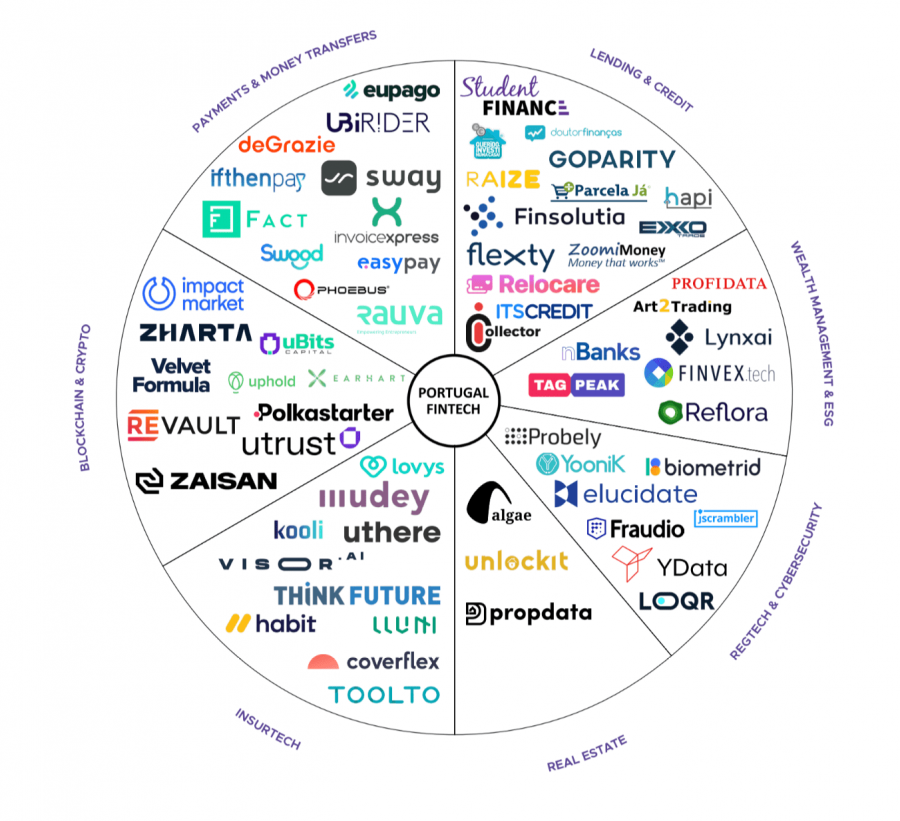
The Fintech market in Portugal is a growing environment where many startup talents join strengths and drives Portugal’s innovation forward. Many different players are creating solutions to support this growing ecosystem, such as The Fintech House or the 4th edition of Portugal FinLab Binance, an innovation hub which supports the development of innovative solutions in FinTech and related areas. 

Portugal’s Fintech industry looked like this in 2022

Cryptocurrencies also have an important place in the Portugal tech scene as Portugal is known for its friendly approach to crypto, and its decentralised model is shaping other things, like social networks:

«The cryptocurrency market is advancing, while the emergence of decentralised social networks should also be an important factor. …social networks will be able to reward users financially or in other ways.» Decentralisation will not happen overnight (some economists say it will never happen)

We can expect to see more financial innovation emerge from Portugal in the coming years as regulations, companies, and cultural mindsets shift into a progressive and innovative approach. This could mean that Portugal becomes an international hub for FIntech, financial innovation and new banking. 

Portugal is also working towards becoming a reference in terms of sustainability, another macro-trend expected to grow a lot in the coming years as startups and companies consider a more conservative growth to preserve resources for our planet. 

Portugal Blue is an initiative designed to support companies in the Blue Economy, which focus on exploiting, preserving and regenerating the marine environment. The Faber Blue Pioneers Fund is one initiative to support this growing sector, investing in the early stages of companies that positively impact ocean sustainability and climate action

Portugal is preparing to embrace the future of tech, and by 2030, it expects its economy to support a healthy job market where technology is accessible and easy to use. This goal goes hand in hand with training and working towards having efficient tech that improves people’s quality of life. Some of the goals Portugal has set for itself for the 2030 Vision Plan are: becoming a reference in tech Education and Training, being a key provider of Advanced Computing Software and Services, and having one of the biggest digital offers for graduates and post-graduate courses in the world: 

«AI technologies supported by academia involved in high-level, fundamental, and applied research. AI technologies will be easily available to promote the efficiency and quality of all activities, including SMEs, public services, and citizens. The labour force will be highly qualified, and Portugal will be at the forefront of AI Education for all. AI will improve the quality of services and processes’ efficiency while guaranteeing fairness, well-being, and quality of life”.

An example of Portugal’s efforts to actively prepare for the future is Advanced Computing Portugal 2030, a programme that seeks to promote and expand Advanced Cyberinfrastructures (CIA) for 2030, fostering all fields of advanced scientific computing, as well as the mobilization of data processing effectively in all sectors and industries.

Another useful example is how Portugal is preparing to build future tech now. A consortium led by Unbabel will create more than 210 jobs in AI development, with a 78 million euro investment. Portugal will be able to position itself at the forefront of responsible artificial intelligence, impacting the economy with 250 million euros in exports by 2030 as a result of the development of 21 new AI products.

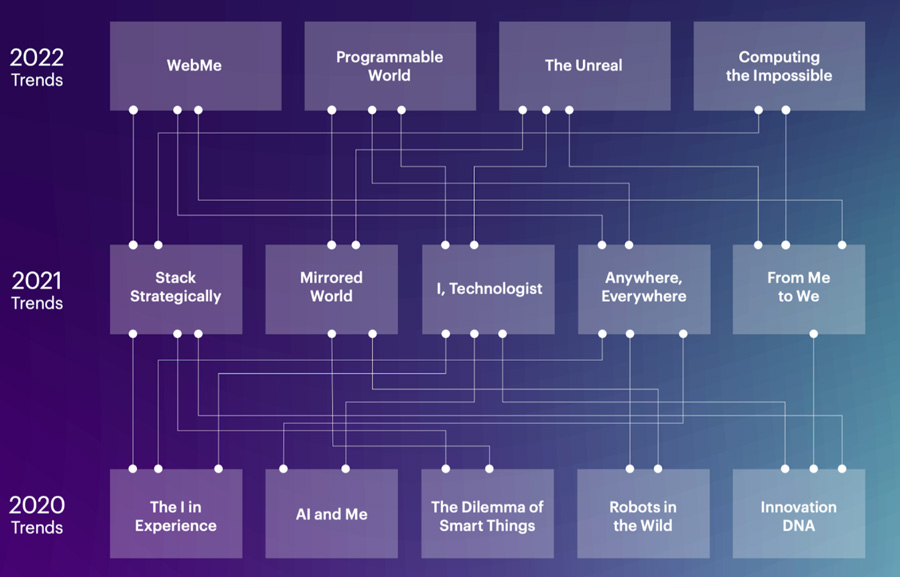
According to a Portugal Accenture study called Meet me in the Metaverse, in 2021, we saw some interesting trends regarding the democratisation of tech (what they call “I, technologist”), a new landscape of partnerships between enterprises and the explosion of remote work. In 2022, however, the unreal became real with the advances in AI, and customisation became a priority for users. 

In the next chart, you can see a map of the bigger social-tech trends they have identified: 
Tech meets culture

Digital technology is no longer represented exclusively by the tech industry: it’s already a social and cultural concept. Digitalisation continues to become a relevant part of the consumer experience. According to Trendwatching, the digital component is a recurring point in the coming macro trends in all economic sectors. 

Trends such as Virtual experience, Shopstreaming, Virtual assistance, A-commerce, and Virtual Status are predicted to continue growing and have a presence in all industries, not only as an alternative option but as a central axis of the communication channels with the consumer.

As pointed out by Deloitte (2022), we went from a society where the digital world only applied to IT to a society in which everything is digital and “the cloud goes vertical”:

The center of gravity around digital transformation has shifted from meeting the IT needs of an industry-agnostic organization to meeting the unique strategic and operational needs of each sector and even subsector. Hyperscalers and SaaS vendors are working with global system integrators and clients to provide modularized, vertical-specific business services and accelerators that can be easily adopted and built upon for unique differentiation”.

Hybrid and remote work, as a workplace trend,  is becoming increasingly important for tech workers as it offers several benefits, and the last several years have proven that this social and work trend is here to stay. Flexibility is one of the main advantages, allowing employees to work from anywhere, which can be especially beneficial for those with family or other personal responsibilities. Remote and hybrid work can also lead to increased productivity as workers have more control over their environment and are less likely to be interrupted by office distractions. 

Additionally, remote and hybrid work can increase diversity in the workforce, as it allows people from all backgrounds to participate in the workforce regardless of their location or other factors.

Consumers, users and workers are on all sides of the tech industry experiencing cultural changes as technology moves forward and reshapes our world. Understanding tech isn’t possible if we don’t understand the humans behind it, their needs and fears or their motivations. The future of tech consumerism is already here

 As we move towards 2023, new developments in AI and other technologies have sparked meaningful conversations about ethics in the tech industry, the role of human tasks in the market, and how we can prepare for the challenges and changes that lie ahead. These conversations, which touch on topics such as tech ethics, human-machine relationships in areas like art, education, and research, and the impact of new technologies in a wide range of fields, are far from over. In 2023 and the years to come, we can expect to delve deeper into issues of accountability, ethical progress, and human safety in the face of a rapidly changing tech landscape. It’s worth mentioning that these discussions and debates are both technical, social and cultural and must be considered from multiple perspectives.

Student testimonials

For many,  the covid-19 pandemic was a reflective experience that impacted many aspects of their life, including their career path. This was the experience of a former Ironhack student, Tomás,  who discovered himself thinking about what next steps to take in his career during the first waves of the pandemic. 

His decision was not only influenced by the prospect of better jobs opportunities but also as a chance to do something more creative and aligned with what he wanted for his future:

«I was looking at design, I’m not going to say careers, I was looking at design courses because I knew I wanted to pursue something in a more creative route. And I came across UX and UI design on YouTube. So I started to look a bit more about it and what it meant, and I understood that I really liked what I was reading about the opportunity».

For him, Ironhack’s reputation was a decisive factor in his choice: 

Soundbite:

 «I talked to a friend who was a recruiter in an It industry and in an It company, and I asked him, I want to do UX UI Design. I see that here in Lisbon we have at least three schools. If I want to get hired quickly, which one should I choose? And he said, oh, no, IronHack, of course. So for me, that was really an important factor in the decision to actually take the course and do the BootCamp«. 

Career week was highlighted as attractive during the training as a way to enter the labour market, practice skills and network. Tomás points out that Career Week was an opportunity to learn:

«How to sell ourselves interviews and how to build us, not how to build our portfolio, but how to sell ourselves interviews because, during the boot camp, we had to have our CV ready«. 

He also notes many tips and solid advice that successfully helped him enter the job market:

Soundbite:

Send them a message. Tell them that you’re a junior and that you want to start your experience with that company because you identify, with them, for example, and let them know that you’re available and send them your CV. And another thing that they told us, which was amazing, was like, always finish your sentences with a question… Many tips that help to facilitate the job search«.

Conclusions

The technology industry in Portugal has been experiencing rapid growth, making it one of the most attractive locations in Europe for tech companies and workers. To maintain competitiveness, stakeholders in the industry have developed strategies to close the gaps in terms of digitization and training compared to European leaders. The Portuguese government is also actively promoting state support and programs to attract investment in technology. This, coupled with a strong tech ecosystem, including a thriving start-up scene, various communities, and events, make Portugal a prime destination for technology companies and professionals.

The COVID-19 crisis has further accelerated the changes in the technology industry and highlighted the need for digital development in the country. As a result, new ways of working have emerged, including remote and hybrid models, which have been recognized as effective and are becoming more normalized. This evolution in working conditions has led to new forms of recruitment, different skill sets and the use of new tools in a digital work environment.

Portugal has a well-trained and skilled workforce, with many professionals proficient in English, which is above the average of other countries in the region, such as France, Spain, and Italy. However, the high demand for talent still requires more training and strengthening of technical skills in order to be competitive. The talent shortage has led to the development of an educational ecosystem outside of academia, with companies providing training and bootcamps becoming more established in the industry. Online training is also becoming an essential part of the educational tech ecosystem. Also, hubs and networking communities play a key role in mentoring, skills training and entrepreneurship development.

As per recent studies, there is a growing trend towards reskilling and upskilling in the technology industry in Portugal. Reskilling is becoming more frequent for professionals wanting to change their career path or take advantage of the wider job market with more attractive working conditions and higher salaries. Upskilling is also important due to the constantly changing nature of the tech industry. Technical knowledge is essential, but the industry also emphasises soft skills such as motivation, passion, autonomy, adaptability, teamwork, communication, change, and analysis. Furthermore, Human resources experts and leaders in the industry emphasize the importance of having a good balance between technical and soft skills, which are considered key competencies to efficiently work within the sector and face the challenges that arise.

Diversity and inclusion are becoming increasingly important in the technology industry in Portugal. The sector recognizes it as a weakness and an area for improvement. Programs are being developed to promote a more inclusive industry as the numbers of diversity and inclusion, specifically in terms of gender, still do not represent 20% of the sector. There is still a long way to go in this aspect.

The technology sector in Portugal is growing despite the crisis forecasts for this year. It’s worth mentioning that the need for a diverse talent pool is becoming crucial due to accelerated growth. Therefore, strategies are being developed to attract talent, taking into account multiple aspects, which creates multiple opportunities within the industry and can help to meet the increasing demand for skilled workers. The industry recognises that a diverse and inclusive workforce can bring multiple benefits, such as new perspectives, ideas, and experiences that can lead to a more innovative and adaptable industry that can better serve a diverse customer base.

Table of Contents

Digital Technology Vision in the France

Digitalization: the roadmap to innovation and technology

A newcomer startup hub

Portugal: catching up with Europe’s performance

Workplace gap: existing problem between supply and demand in digital technology

Gender gap. How big is the gender gap in the digital tech industry, and how is it affecting the sector​

The training offered by Ironhack to alleviate this problem

What do experts say?

Web development

Trends by sectors:

Data Analytics

UX/UI Design

Cybersecurity

Product Management

Career Development

Experience of employees with career changes

New future trends and paradigm shifts

Portugal: preparing for the future

Tech meets culture

Student testimonials

Conclusions

Where do you wanna go?

What is this study about?

Ironhack is the second biggest school in the world, with more than 10.000 students. They have 10 campuses and since Covid, have started an online teaching program. They are specialized on digital technologies, and their main focus is to reduce the gap between supply of workforce and the demand of the companies.

From 2023 on, they want to start publishing reports to position themselves as thought leaders in tech areas. They have contacted us to help them build this reports. We’ll start building the State of Tech in 2023 report, to be ready this January. If the relationship goes on, they will need another report on september.

IRONHACK wants to use this report as a source of knowledge to build “hero content” for their communication channels throughout the year.

Thanks to this efforts, they expect to:

  1. Drive brand awareness online.
  2. Establish their brand as thought leader in the tech industry recruitment space.
  3. To show how well they understand the skills gap in the sector.
  4. To gain more lead for the top of the funnel.
  5. To drive more traffic to their website.
  6. To nurture their funnel, resulting in more apps.

Audience of the contents of this report:

  1. B2C: Career changers and recent grads, looking to understand the viability of a career in tech, the long term benefits of getting into tech and what kind of jobs are out there in 2023. They should come away from reading the report feeling motivated to get into tech, with an idea of what job they want and how to get it.

  2. B2B: Hiring managers and recruiters, looking to understand the skills and current pools currently available in the market. They should come away from reading the report feeling more certain of the kinds of profiles they should be looking for.

The study includes: 

  • 9 Reports on the State of Digital Tech 2023, in 9 countries. 
  • 1 Global Report on the State of Digital Tech 2023. 
  • 1 light Gender Report.
  • 1 Global Survey about the State of Digital Tech 2023.
  • 109 Interviews

Interviews: 

  • 9 Ironhack Local Outcome Managers
  • 9 Gender Experts
  • 18 Ironhack Students
  • 18 Key Opinion Leaders (KOL)
  • 27 Chiefs
  • 27 Career Changers

Discover more about this study in the Research Proposal

Chose your country

Europe

New!

America

Europe

UK

PO

FR

NL

GM

SP

America

The Survey

The Survey was intended to be delivered in for this research through LinkedIn Ads, but after designing the campaigns and test-launching it, we noticed bad results in terms of Survey submissions. 

The Survey strategy is being rethought at the moment. 

You can access the ongoing Survey here.